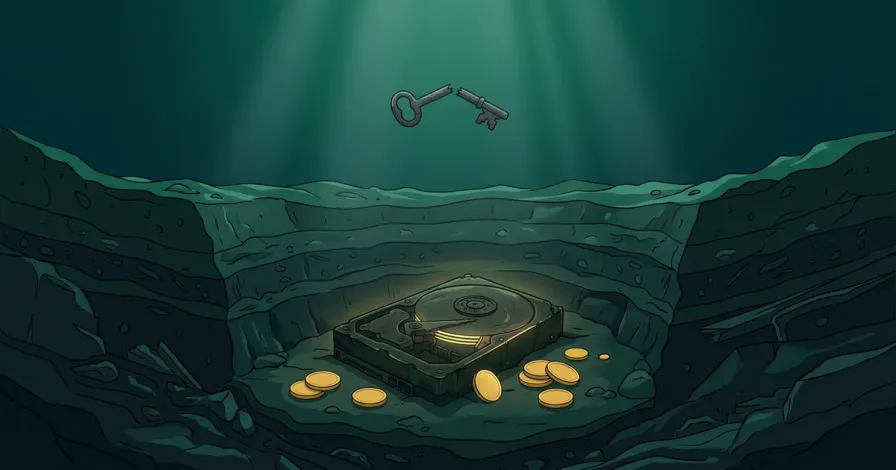
In a landfill in Newport, Wales, there is a hard drive holding the keys to 8,000 bitcoins. Its owner has spent more than a decade trying to get it out, and the British courts have closed the door on him. It is not a rare case: millions of lost bitcoins are estimated to remain recorded on the blockchain with nobody able to move them ever again.
The short answer: a bitcoin is not lost because it disappears, but because someone loses the key that allows it to be moved. Estimates range from 2.3 to 3.8 million BTC, between 11% and 18% of the 21 million that will ever exist. At CryptoImpuestos we have gone through the best-known cases, and we explain how to keep it from happening to you and what the Spanish tax agency (AEAT) does (and does not) say when you lose access to your crypto.
 How many lost bitcoins are there?
Nobody knows exactly, and it is worth saying so from the start. On the blockchain, a lost coin and one held by a very patient owner look exactly the same: both are sitting still. That is why every figure in circulation is an estimate, almost always based on how long the coins have gone without moving.
The most cited ones:
- Chainalysis (June 2020): about 3.7 million BTC probably lost, close to 20% of what had been issued at the time. It counted as lost the coins that had not moved in at least five years.
- Ledger: its guide, from May 2025 and revised in October 2026, gives a range of between 2.3 and 3.7 million BTC.
- Unchained: in a 2018 analysis revised in April 2026, it estimates between 3 and 3.8 million BTC based on the age of unspent coins.
Put the ranges together and you get between 2.3 and 3.8 million lost bitcoins. Against the protocol’s cap of 21 million, that is between 11% and 18%.
There is an important nuance: not every coin that sits still is lost. Some people bought in 2011 and have simply never sold. That is why the ranges are so wide, and why none of these figures should be read as a count.
 What you lose is the key, not the coin
To understand why bitcoins get lost, you need to understand where they are. They are not on your phone or on a USB stick. They are recorded on the blockchain, a public ledger shared by thousands of computers that says how much belongs to each address.
To move what is in an address, you have to sign with its private key. Modern wallets generate those keys from a seed phrase of 12 or 24 words. Whoever has those words can move the coins from anywhere in the world. Whoever does not, cannot, even if they are the rightful owner. We explain it from scratch in what a crypto wallet is.
That is why there is no “I forgot my password” button. Nobody keeps a copy of your key: not the network, not the company that made your wallet. It is the opposite of what happens on an exchange, where the platform holds the keys for you. If you are thinking of taking that step, how to move crypto to your wallet shows you how to do it without mistakes.
 James Howells: 8,000 bitcoins in a Welsh landfill
This is the most famous case. According to the judgment of the High Court of England and Wales, James Howells mined 8,000 bitcoins in early 2009, when they were worth almost nothing. In August 2013, the hard drive where he kept the keys ended up by mistake in the Docksway landfill in Newport, which is owned by the city council.
For years he asked for permission to dig and even offered the city a share of whatever he recovered. The council refused, and he took it to court: he asked for the drive to be returned, to be allowed to search for it or, failing that, compensation for the value of the bitcoins.
It never went to trial. On 9 January 2025, the court ruled in the council’s favour: under a 1974 British law, whatever is deposited in the landfill becomes the property of the authority that runs it. And the judge left a line that sums up this article: the bitcoins are not “inside” the drive. What it held was the record of the private key.
On 13 March 2025, the Court of Appeal refused him permission to appeal because the appeal had no real prospect of success. The drive, if it is still in one piece, is still under the rubbish. And the 8,000 bitcoins are still on the chain, in plain sight and untouchable.
 Stefan Thomas: two attempts for 7,002 bitcoins
The second case has no landfill, but more suspense. In January 2021, The New York Times told the story of Stefan Thomas, a German-born programmer living in San Francisco. He has 7,002 bitcoins in a wallet whose keys are stored on an IronKey, an encrypted USB stick.
The IronKey gives you 10 attempts to get the password right. After that, it locks up and encrypts its contents forever. Thomas wrote the password down on a piece of paper and lost the paper. When he spoke to the newspaper, he had already tried the eight passwords he usually used: he had two attempts left.
Thomas put the device away, waiting for someone to find a way to open it without using up attempts. His case teaches something that does not make the headlines: a very secure system protects you from a thief just as much as it locks out its own owner.
 Satoshi Nakamoto: lost or just sitting still?
The largest amount of unmoved bitcoin is attributed to Bitcoin’s creator himself. By analysing how the first blocks were mined, researchers such as Sergio Demian Lerner identified a mining pattern they attribute to Satoshi Nakamoto. That is where the most repeated figure comes from: about 1.1 million BTC.
It is an estimate with a wide margin. Some researchers lower it to between 600,000 and 700,000 BTC and others raise it to 1.5 million. What The Block does note is that those coins have never been spent since they were mined.
Nobody knows whether Satoshi still has the keys, lost them or decided never to touch them. That is why his coins are the best example of why lost-bitcoin figures are estimates: many count those coins as lost, but a single signature would be enough to prove otherwise.
 Can lost bitcoins be recovered?
Almost never. If the seed phrase is gone and the password was a good one, there is no shortcut: Bitcoin’s cryptography is designed precisely so that nobody can guess a key.
The exceptions come when there is a flaw somewhere else. In May 2024, The Block reported that security researcher Joe Grand and his collaborator Bruno had recovered 43.6 BTC, nearly 3 million dollars at the time, from a wallet created in 2013. Its owner had generated the password with the RoboForm password manager, and that version of the program had a flaw: the passwords it generated depended on the date and time. By narrowing down when it was created, they managed to reproduce it.
Look at what has to happen for this to work: a specific flaw in the program, the clue of a date and someone with the know-how to exploit it. It is not the norm.
And a practical warning: if you have lost access to your crypto, expect to see adverts for “recovery services” that ask for your seed phrase or an upfront payment. They are one of the most common scams. If it has already happened to you, you will find the steps in what to do if you have been scammed with crypto.
 How not to lose your bitcoins: seed phrase, copies and inheritance
None of these cases needed expensive technology to be avoided. They needed a well-kept piece of paper. The basics:
- Write the seed phrase down on paper, or engrave it on a metal plate if you want it to survive fire and water. By hand and in clear writing.
- Make more than one copy and keep them in different places. If both are in the same drawer, a fire or a house move takes them together.
- Never in a photo, in the cloud, in your email or in a note on your phone. Anything connected can be stolen or deleted without you noticing.
- Do not give it to anyone. No technical support, exchange or manufacturer will ever ask you for it.
- Do a recovery test. Before moving a significant amount, restore the wallet from the phrase on another device or after resetting it, and check that you can see the balance. If the phrase is copied wrongly, better to find out with a small amount than with everything.
- Buy the hardware from the official source. A tampered device can steal the words before you even use them. We cover it in how to buy a secure wallet.
- Think about inheritance. Make sure at least one trusted person knows that the crypto exists, where the copies are and how to use them. You do not need to give them the phrase today: clear instructions kept where they will find them are enough.
The last point is the one most often forgotten. Bitcoins that nobody knows exist are, for your family, lost bitcoins.
 Does losing your keys count as a loss for the Spanish tax agency?
You need to be careful here, because it is easy to think that if you can no longer use your bitcoins, you can deduct their value in your income tax return. It is not automatic.
First: losing access is not selling your crypto or swapping it for other crypto. There is no transfer, so no gain or loss is calculated as it would be on a sale.
Second: we have not found any ruling from the Dirección General de Tributos (DGT, the body that issues the Spanish tax authority’s binding rulings) dealing specifically with lost keys or a lost seed phrase. The closest are thefts and scams. In binding ruling V1828-24, of 1 August 2024, the DGT looked at the case of a person scammed with crypto and accepted that there can be a capital loss, but only if it is justified with valid evidence. In that case, as it does not come from a sale, the loss goes to the general part of the tax return, not the savings part. Note: it was a scam, with a police report and supporting documents. Without evidence, the Spanish tax agency may consider that the loss has not been justified. And if what happens is that an exchange goes bankrupt or does not return your coins, that is not an immediate loss either: you still have a right to be paid, and the loss is only allocated when certain milestones in the insolvency proceedings or the court claim are reached.
With lost keys, the problem is precisely the evidence. The coins are still visible on the blockchain and nothing proves, from the outside, that you cannot move them. On top of that, they sometimes reappear, as in the case of the 43.6 BTC. That is why we will not tell you that you can declare it as a loss: it is a case that has to be studied with its documents.
And one idea that applies to everyone who keeps their own crypto: if you hold it yourself, your history is your responsibility too. No exchange will give you a report of what happens in your wallet. Download your history from the platforms where you bought and be clear about which addresses are yours. We explain how in how to extract your wallet activity.
Summary: lost bitcoins in five points
| Situation | What happens | What to do |
|---|---|---|
| You lose the seed phrase | The coins stay on the chain, but nobody can move them | Keep several copies on paper or metal, in different places |
| You forget the password of an encrypted device | It may lock after a few attempts | Write it down and keep it with the copies of the phrase |
| Someone offers to recover them | It is usually a scam | Never give out the phrase or pay upfront |
| The holder dies without leaving instructions | The family may not know they exist | Leave instructions with a trusted person |
| You want to declare it as a loss | There is no specific DGT criterion for lost keys | Study the case with the evidence you have |
 Frequently asked questions
How many lost bitcoins are there in total?
Nobody knows exactly. The most cited estimates range from 2.3 to 3.8 million BTC, between 11% and 18% of the 21 million that will ever exist. They are based on coins that have not moved for years, and some of them may simply be in storage.
If I lose my seed phrase, can I recover my bitcoins?
If you still have access to the wallet, create a new one with a different phrase and move your funds there as soon as possible. If you have lost both the phrase and access, in practice there is no way to recover them. Nobody keeps a copy of your keys.
Can I declare the bitcoins I have lost on my income tax return?
It is not automatic. Losing your keys is not a sale, and we have not found a DGT criterion for this case. For thefts and scams, the DGT requires the loss to be justified with evidence. If you are in this situation, it is worth studying it with your documents.
Where is the safest place to keep the seed phrase?
On paper or metal, away from any connected device, with at least two copies in different places. Never in photos, in the cloud or in your email.
What happens to my crypto if I die and nobody has the keys?
It stays on the blockchain, but your heirs will not be able to move it. Leave clear instructions with someone you trust: they should know it exists, where the copies are and how to use them.
Let your keys be the only thing you have to keep yourself
If you keep your crypto in your own wallet, keeping your transactions in order is also down to you. Send us your history and we will generate the document with all your exchanges and wallets using the global FIFO method required by the Spanish tax agency.
Sources: Judgment Howells v Newport City Council [2025] EWHC 22 (Ch) · Decrypt: Howells loses his appeal (14/03/2025) · The New York Times: Lost Passwords Lock Millionaires Out of Their Bitcoin Fortunes (12/01/2021) · The Block: 43.6 BTC recovered from a 2013 wallet (28/05/2024) · The Block: the 1.1 million BTC estimate for Satoshi · Decrypt: Chainalysis’s 2020 estimate · Ledger: How many Bitcoin are lost? · Unchained: The geology of lost coins

Víctor Lázaro
Marketing Director, Cryptoimpuestos.es