
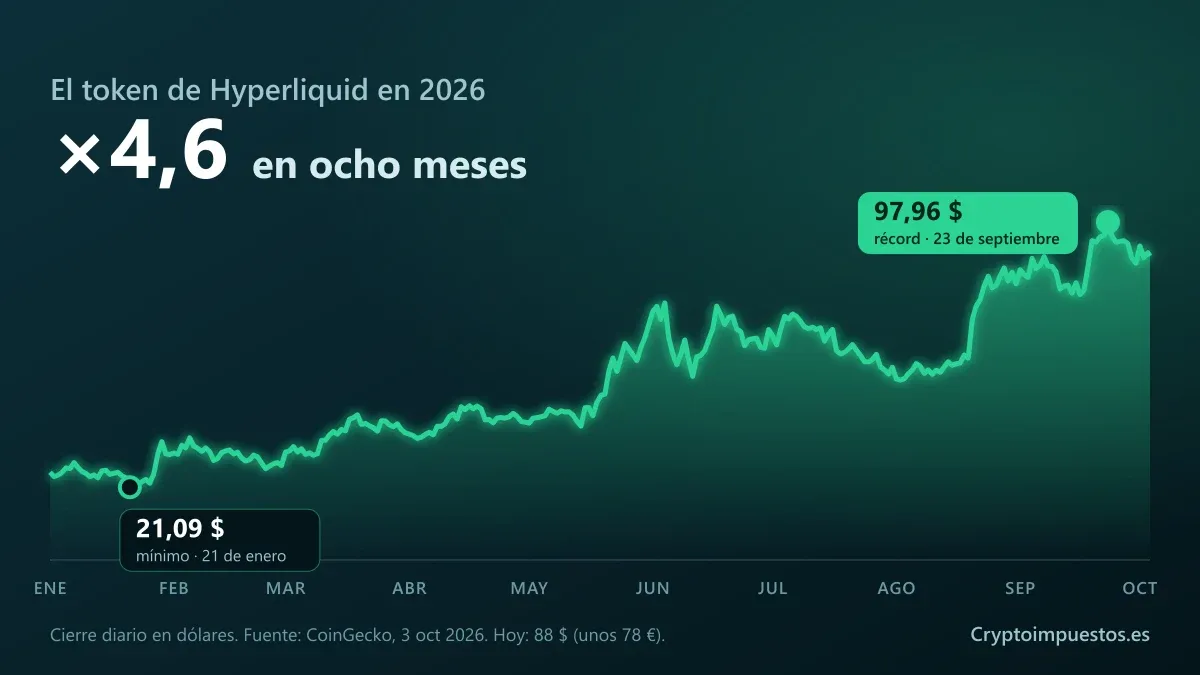
Nine months ago, a token called HYPE was worth $21. On 23 September it hit $97.96. Along the way it has broken into the top 15 cryptocurrencies by market capitalisation, Wall Street has built three ETFs around it, and Binance, which had gone almost two years without listing it, finally gave in on 24 September.
And this week is packed: today, 3 October, brings the first payment from a mechanism that turns the yield on billions in USDC into HYPE buybacks; on Tuesday 6 October, 9.92 million tokens unlock, worth around $860 million; and on Wednesday 7 October the team itself is due to sell another 3.75 million in a private deal.
Behind all of this is a platform that doesn’t ask for your ID, doesn’t hold your money and has no office you can call. It’s called Hyperliquid, and if its name has been everywhere you look this month, here is what you need to know before you get close.
 What is Hyperliquid, in 30 seconds?
Hyperliquid is two things at once: its own blockchain and a decentralised exchange that runs on top of it.
Its flagship product is perpetual futures: contracts that let you bet on the price of a cryptocurrency going up or down, with leverage and no expiry date. You don’t buy bitcoin; you bet on its price, and you can do it with far more money than you actually have.
What has set it apart is that it feels like a centralised exchange. It has a real order book, like Binance, with the same ladder of bids and asks and near-instant execution. But every order is recorded on the blockchain and the funds sit in your wallet, not in a company’s account.
Three features sum it up:
- No KYC. No sign-up and no identity checks. You connect a wallet and trade.
- No custody. Nobody holds your funds for you. If you lose your keys, there is no one to complain to.
- No venture capital. The project, led by Jeff Yan, was funded without investor rounds, which is rare in the sector and explains part of what comes next.
 The numbers that put it everywhere
Hyperliquid is no longer a niche experiment. In early September, the money committed to open positions topped $14.6 billion, roughly six times more than its closest rival among decentralised exchanges. It accounts for about 70% of active users on this type of platform and around 11% of all perpetual futures open interest worldwide, centralised exchanges included.
The token has followed the same path. HYPE is worth about $88 today, roughly €78, with a market capitalisation close to $19.6 billion.
 Why has HYPE risen so much?
There isn’t one reason but several, all landing in the same year.
Buybacks. Most of the fees the platform generates go into buying HYPE on the market. More volume means more buying of the token, every single day. In June, validators approved a second source: around 90% of the yield generated by the USDC deposited on Hyperliquid, the result of a deal with Circle and Coinbase announced in May, will also go to buybacks. The first payment arrives today and will repeat every 30 days.
ETFs. Bitwise, Grayscale and 21Shares have exchange-traded funds on HYPE in the United States, which reached around $502 million in September. A DeFi token with ETFs alongside bitcoin and ether was unthinkable a year ago.
Binance. The world’s largest exchange listed it on 24 September, with three spot pairs. But with the Seed Tag, the label it keeps for high-risk assets: to trade it, Binance makes you pass a risk quiz every 90 days.
The airdrop that started it all. In November 2024, Hyperliquid handed out 31% of all its tokens to users who had traded on the platform. With no investors selling at launch, a huge user base kept the token. In total, 310 million HYPE.
 The small print: what almost nobody tells you
This is where the “how to multiply your portfolio” videos fall short.

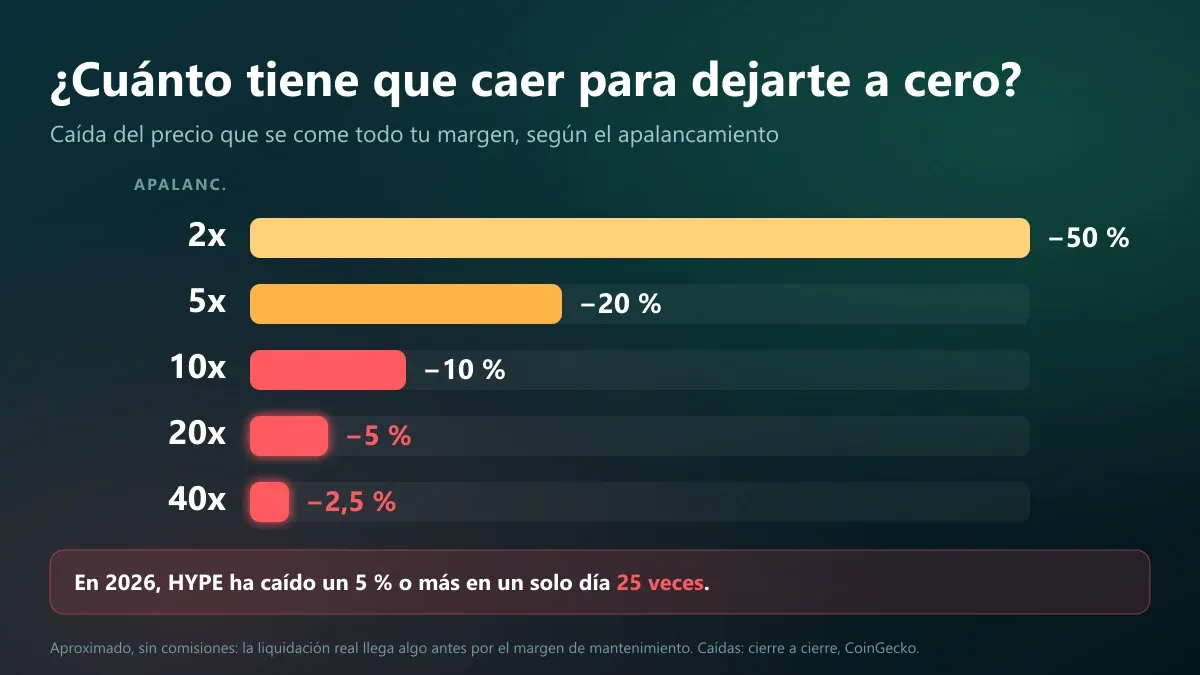
Leverage cuts both ways. With high leverage, a small move against you liquidates your position and you lose your entire margin. To put it in perspective: so far in 2026, HYPE has fallen 5% or more in a single day 25 times, and at 20x any one of those days is enough to wipe out a long position. On Hyperliquid, liquidations are public too: anyone can see the big traders’ positions in real time and the price at which they would be liquidated. In February 2026 the platform saw more than $1 billion in liquidations. In June, a well-known trader’s long ether position was liquidated seven times in ten hours.
Manipulation happens. In April, several analysts spotted a coordinated attempt on FARTCOIN: someone built a $15 million position spread across four wallets and triggered their own liquidation in a thin market. The $1.5 million bill was paid by the platform’s liquidity vault, which is funded by the users who deposit into it.
Decentralised, but not that much. The network is run by a small number of validators, and in moments of crisis they have taken quick decisions, such as delisting a market, that would have triggered an investigation at a centralised exchange. It works, but it’s worth knowing that lever exists.
Unlocks. Almost 10 million tokens are released every month to the project’s contributors, and that will continue until 2027 or 2028. The 6 September unlock was already worth around $800 million, and next Tuesday’s is close to $860 million. Whether the market absorbs it is, every month, an open question.
Nobody on the other end. There is no customer service, no guarantee fund and no one to complain to if you send funds to the wrong address or sign a malicious transaction. Mistakes can’t be undone.
 Is it legal to use Hyperliquid from Spain?
That’s the million-dollar question, and the honest answer is that it sits in a grey area.
Since 1 July 2026 the European MiCA regulation has applied in full in Spain, and it only allows crypto-asset services to be provided by firms authorised by the CNMV (Spain’s securities regulator) or another European supervisor. But perpetual futures are derivatives, and in the European Union derivatives are governed by MiFID II, the financial instruments rulebook, not by MiCA. Hyperliquid is authorised under neither, and it doesn’t work like a traditional exchange either: there is no company holding your money or signing you up as a customer.
The duty to hold a licence falls on whoever provides the service, not on whoever uses it. We haven’t found any CNMV warning specifically about Hyperliquid, or any rule that bans an individual from connecting their own wallet to a decentralised protocol. What is clear is what you give up: any investor protection. If something goes wrong, neither MiCA nor MiFID II covers you.
For context: on the crypto CFDs offered by a broker authorised in the EU, leverage for retail clients is capped at 2:1 under the ESMA measures that the CNMV keeps in force in Spain. On Hyperliquid you can trade with up to 40x.
This article is for information only: we don’t recommend trading on Hyperliquid or on any particular platform. If you already do, your trades are taxed just as they would be anywhere else.
 Why “no KYC” doesn’t mean anonymous
The usual route has four steps, and only the first goes through someone who knows who you are.
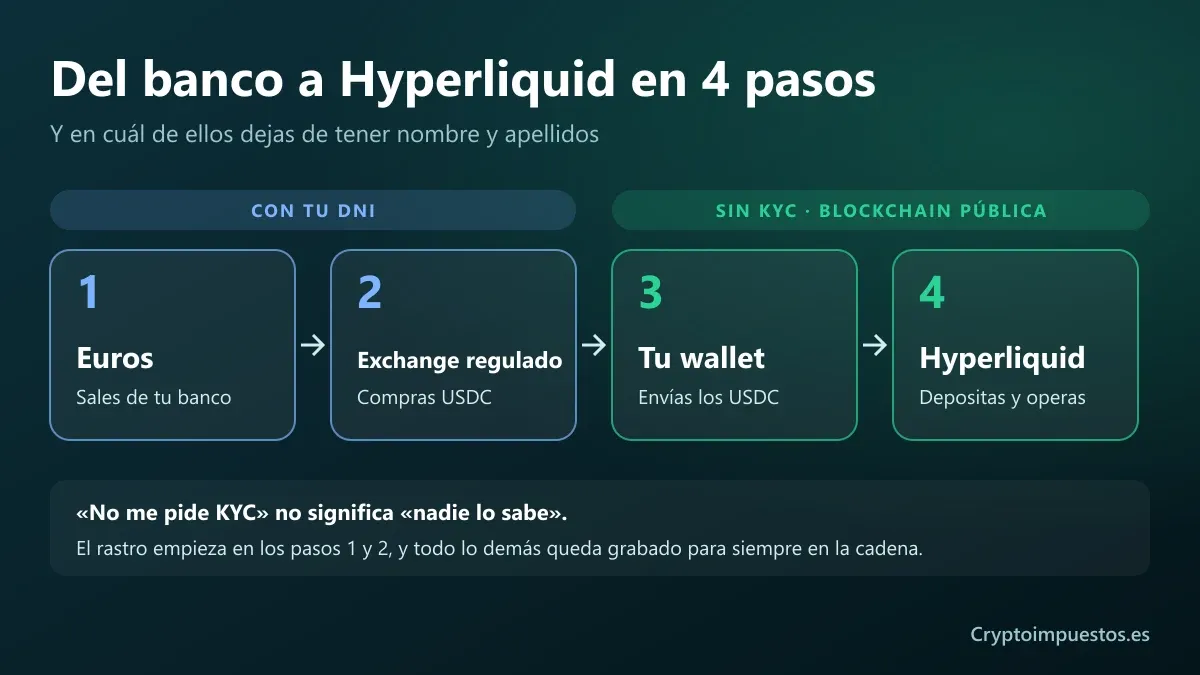
That first stretch, the bank and the regulated exchange, is the one with your name on it. And it’s exactly why “it doesn’t ask me for KYC” doesn’t mean “nobody knows”.
 What about the tax office? What’s taxable even if you never cash out
Hyperliquid not asking for your ID changes nothing about what you have to declare. It changes something else: here, nobody is going to do the maths for you.
The essentials, in four points:
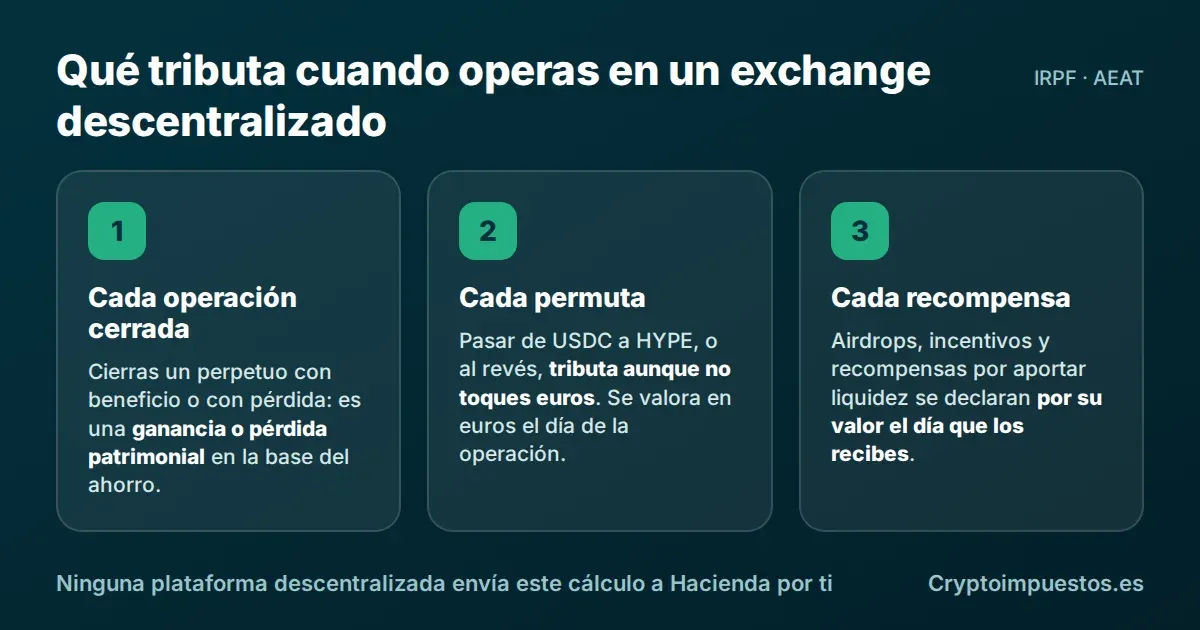
- Every position you close is taxable, not what the screen shows. The gain or loss goes into the savings tax base, at 19% to 30%, even if the result stays in USDC on the platform. Crypto derivatives don’t yet have administrative doctrine as settled as buying and selling, so the exact treatment depends on how you trade: it’s a case for our specialists to review.
- Buying USDC with euros is a purchase and isn’t taxable in itself. Swapping USDC for HYPE, or any crypto for another, is a swap (permuta) and is taxable even if you never touch euros. It’s calculated with the FIFO method.
- The ETF and the token are not the same thing. The ETF is a foreign security you declare using your broker’s report; the token is a cryptocurrency you calculate yourself. On top of that, US ETFs are not usually available to European retail investors.
- Airdrops and rewards are taxed at their value on the day you receive them. On HYPE staking, the DGT (Spain’s Directorate-General for Taxes) looks at platform staking, native staking and liquid staking in its binding ruling V0612-26 of 17 March 2026, and how it applies to you depends on how you stake. We cover it in detail in how staking and rewards are taxed.
Two pieces of good news and one bad. The good: whatever you hold in your own wallet falls outside Modelo 721, because nobody holds it in custody, and declared losses can be offset for four years. The bad: DAC8 won’t do the work for you, because a decentralised exchange doesn’t send that report. If a request from the tax agency ever arrives, rebuilding your trading history is up to you. Write down your addresses and export your history often, as we explain in our guide to extracting your wallet activity.
 Hyperliquid in 8 facts
| Fact | Figure |
|---|---|
| What it is | Its own blockchain + a decentralised perpetual futures exchange |
| Identity checks | None: you connect a wallet |
| HYPE price | From $21.09 (21 January) to $97.96 (23 September) |
| Market capitalisation | Around $19.6 billion |
| Open interest | Over $14.6 billion in early September |
| ETFs on HYPE | Three in the US (Bitwise, Grayscale, 21Shares), around $502M |
| Next unlock | 6 October: 9.92 million HYPE, around $860M |
| EU authorisation (MiCA / MiFID II) | None |
 Frequently asked questions
Is Hyperliquid safe?
It’s technically solid and moves billions every day, but it isn’t safe in the way a bank is. Your funds depend on your wallet and on the bridge you deposit through, there is no investor protection and leverage can liquidate you in minutes.
Does Hyperliquid require KYC?
No. You connect a wallet and trade. But to get there you almost always go through a regulated exchange or your bank, and that part does leave a trail.
Can you buy HYPE in Spain?
Binance listed it on 24 September, but it hasn’t served customers resident in Spain since 1 July. If you want to buy it on an authorised platform, first check the CNMV register to make sure it holds a MiCA licence and lists HYPE.
What is a perpetual future?
A contract that tracks the price of a cryptocurrency without you buying it and with no expiry date. It lets you bet on a fall and use leverage, which is what multiplies both gains and losses.
What happens with the 6 October unlock?
9.92 million HYPE are released to the project’s contributors, between 3.9% and 4.5% of the tokens in circulation. If they are sold on the market, they put pressure on the price; if they stay staked or are sold off the order book, like the private deal planned for the 7th, the impact is smaller.
If I never cash out to euros, do I have to declare anything?
Yes. The tax arises when you close the position or make a swap, not when you move the money to your bank. It’s the most common mistake among people who trade on decentralised exchanges.
Hyperliquid is probably the most eye-catching DeFi story of the year. As eye-catching as it is risky for anyone who goes in without knowing what they’re getting into. If you already trade there and wonder how it fits into your tax return, message us on WhatsApp: our specialists review your trading and give it the right tax treatment. And to get to grips with the basics, see our guide to declaring cryptocurrency in Spain.

Víctor Lázaro
Marketing Director, Cryptoimpuestos.es