
Did you buy, sell, swap or earn crypto during 2025? The Spanish tax agency has found a powerful ally in the exchanges, and it is using it to track down everyone who has traded. With Modelo 721 and the DAC8 Directive now in force, it will find out whether you cooperate or not.
At Cryptoimpuestos we have processed thousands of returns, and if there is one lesson in that, it is this: declaring crypto properly is hard, and it demands order. This guide is the map that takes you to the calm of having everything in its place.
Quick summary: what do I have to declare?
| Situation | Tax obligation |
|---|---|
| I sold crypto for euros at a gain or a loss | Income tax (Renta) |
| I swapped one crypto for another (BTC → ETH) | Income tax (Renta) |
| I earned staking, lending or airdrops | Income tax (Renta) |
| I held more than €50,000 on foreign platforms at 31/12 | Modelo 721 |
| I only bought and I hold it in my wallet | Nothing (for now) |
| My crypto sits ONLY in a cold wallet (Ledger, Metamask, etc.) | Income tax only if you sell or earn |
If any of the first four rows describes you, read on.
The three filings that can affect you
In practice, crypto in Spain creates three distinct tax obligations. Knowing them is the first step to leaving nothing out.
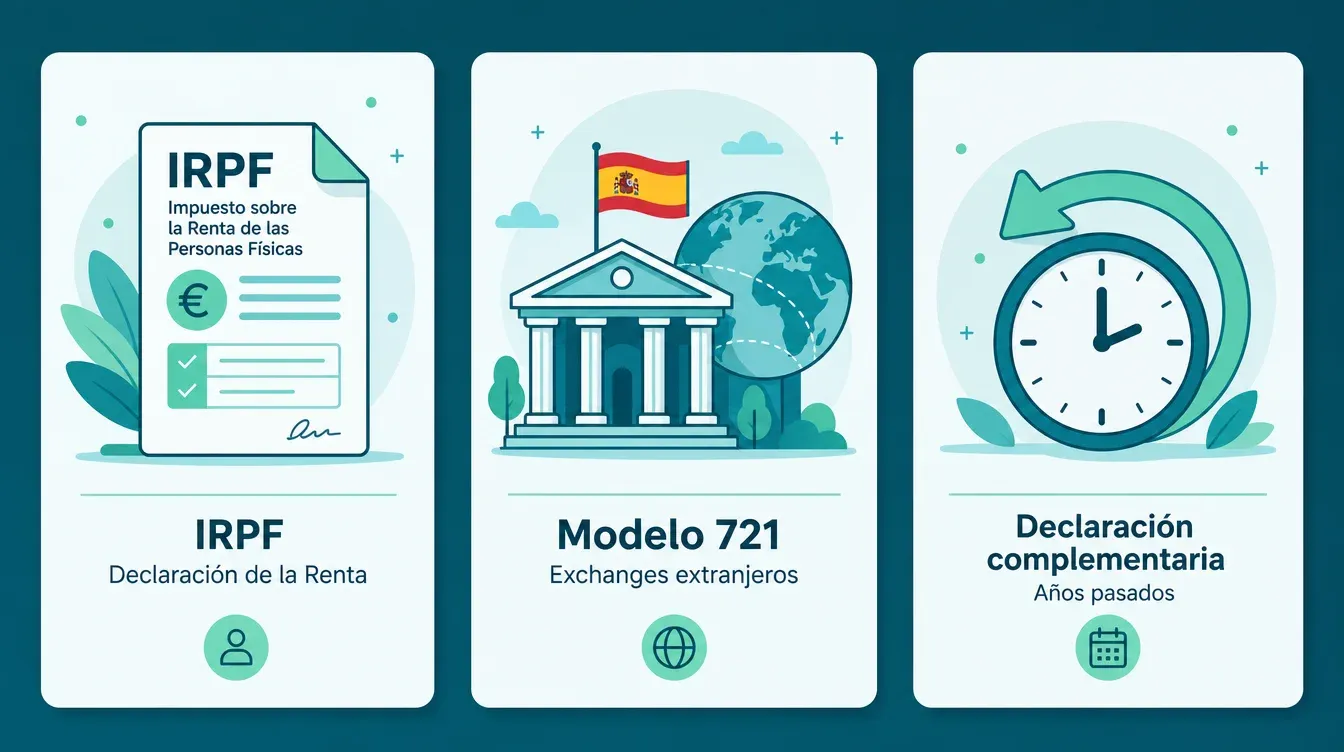
1. Income tax (the annual Renta return)
The annual return where the gains and losses from your crypto activity during the year are taxed. It applies to everyone, whatever the volume.
2. Modelo 721
An informational return (nothing is paid) required from anyone holding more than €50,000 in crypto custodied on foreign platforms at 31 December. Read the full Modelo 721 guide →
3. Amended return
If you did not declare your crypto in earlier years and now want to put that right, the amended return exists for exactly that. Doing it voluntarily cuts the penalties dramatically.
The tax agency can review your position for four years from the end of each year’s voluntary filing window.
So if you have undeclared crypto activity from 2021 onwards, there is still time. For 2020 and earlier the debt is time-barred and cannot be claimed. What to do if you never declared →
Which crypto transactions are actually taxable?
Here is the first myth worth dismantling: you do not need to move money to your bank to owe tax. Every time a transfer of assets happens in crypto, there is a taxable event.
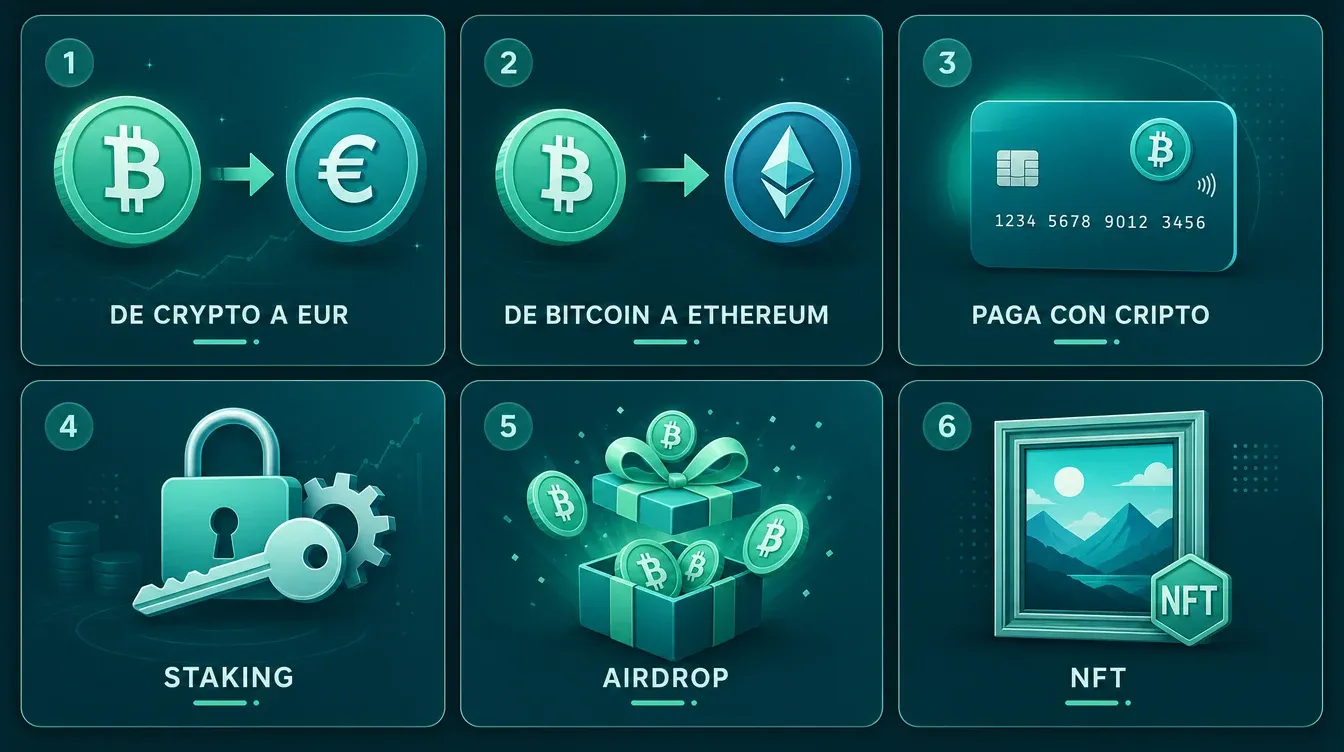
| Transaction | Taxable? | How |
|---|---|---|
| Buying crypto with euros | No | Only the acquisition cost is recorded |
| Selling crypto for euros | Yes | Capital gain or loss |
| Swapping one crypto for another (BTC → ETH) | Yes | Every swap is a disposal |
| Paying for goods or services in crypto | Yes | Equivalent to a sale |
| Earning staking, lending or yield farming | Yes | Investment income |
| Receiving airdrops or forks | Yes | Capital gain with zero cost |
| Receiving an NFT as a gift | It depends | Case by case (gift tax) |
| Simply holding (HODL) | No | But it may count towards Modelo 721 |
Watch out for swaps. This is the most common mistake we see: people who moved BTC into ETH, ETH into SOL and SOL into stablecoins for months without a single euro reaching their bank, convinced none of it was taxable. Every one of those switches is a transaction the tax agency expects to see declared.
How it is taxed: 2025 rates
Gains and losses from selling or swapping crypto are taxed in the savings tax base, alongside dividends, interest and other investments.
| Savings tax base | Rate |
|---|---|
| Up to €6,000 | 19% |
| €6,000 to €50,000 | 21% |
| €50,000 to €200,000 | 23% |
| €200,000 to €300,000 | 27% |
| Above €300,000 | 30% |
Investment income (staking, lending, crypto interest) is taxed in the same savings base at the same bands, but it is calculated differently. See how staking is taxed →
Step by step: how to declare your crypto
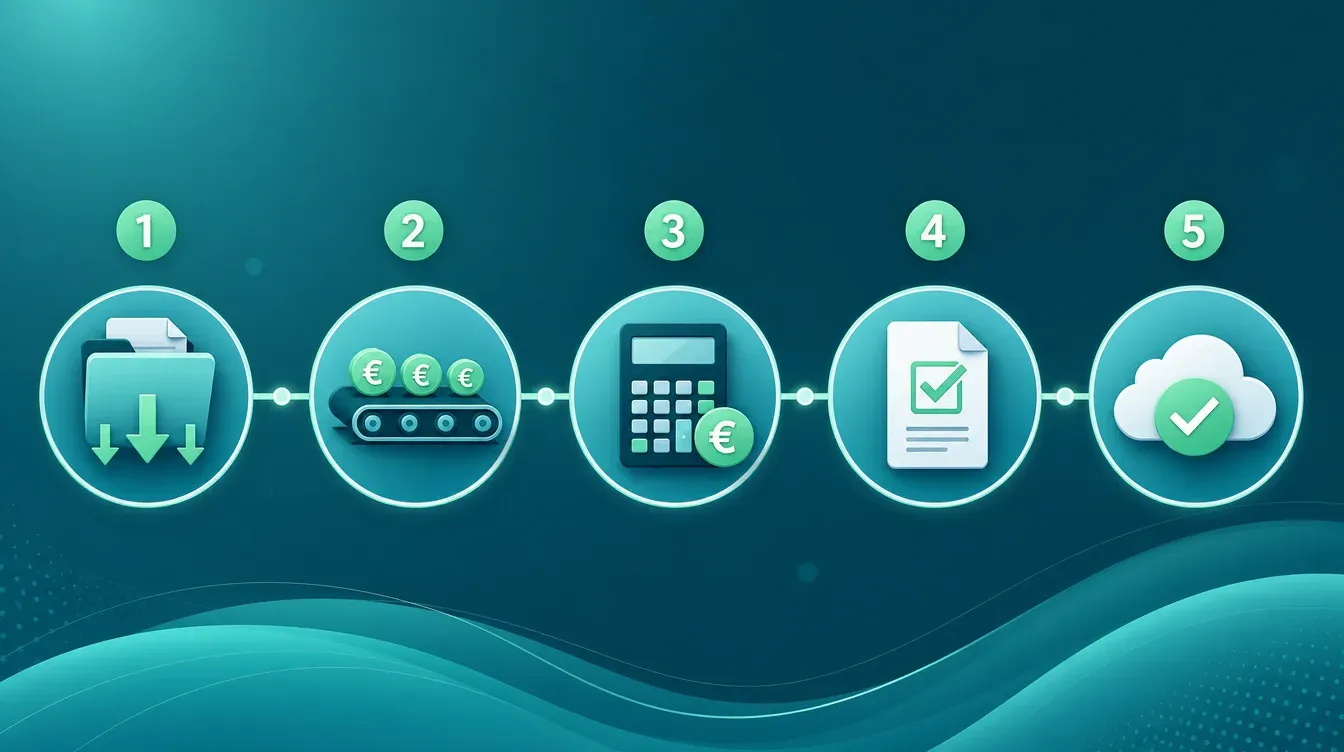
This is exactly how we work with every client who comes to Cryptoimpuestos: you give us access to your activity and we take care of the technical work. What you get back is a tax report with transaction-by-transaction traceability, usable both to file your return and as legal backing if the tax agency ever asks.
If you also want us to prepare the filing itself, it helps to keep your general income-tax paperwork separate from your exchange, wallet and crypto histories.
Step 1: onboarding and a look at your activity
In the first conversation you tell us which exchanges you have used, which wallets you control, how long you have been trading and whether you have done staking, DeFi, NFTs or moved funds between platforms. That already tells us the scope of the report.
You then sign the authorisation to download your history (read-only API access or manual exports). At no point do we touch your funds: we only read transactions.
Step 2: rebuilding the complete history
We download your activity from every exchange and every wallet and merge it into a single timeline.
- We match up transfers between platforms so they are not counted as sales
- We identify swaps, staking, lending, airdrops and forks and classify each correctly
- We recover transactions from collapsed or vanished exchanges (FTX, Celsius, Mt. Gox…)
- We validate balances at 31 December one by one
Step 3: global FIFO calculation and tax treatment
We apply the FIFO (First In, First Out) method across your entire activity — not per exchange, but globally, which is what Spanish rules require. This is where most automatic calculators fall over.
On top of that FIFO we calculate gains and losses, optimise offsets, identify losses that can be carried forward and separate what is taxed as a capital gain from what is taxed as investment income. More on the FIFO method →
Step 4: a traceable tax report (your legal backing)
This is the crucial part. You receive a complete tax report setting out:
- every transaction with its date, amount, market price and the calculation applied
- the FIFO acquisition price behind each sale or swap
- annual summaries by transaction type (gains, losses, staking, airdrops)
- balances at 31/12 valued at the official exchange rate
That report is your documentary evidence in any future review: if the tax agency comes back to you, the figures are justified transaction by transaction. You are not left holding a number — you are left holding the reasoning.
Step 5: filing the return and, where required, Modelo 721
With the report in hand there are two routes:
- you file it, or your usual adviser does
- we file it for you
The report stays with you throughout the four-year limitation period as backing.
Modelo 721: the form almost nobody knows about
If you hold more than €50,000 on foreign platforms at 31 December, then on top of income tax you must file Modelo 721 between 1 January and 31 March of the following year.
Platforms such as Coinbase, Kraken, KuCoin, Bybit, OKX and Crypto.com are foreign and trigger the 721. Others such as Bit2Me or Binance Spain do report to the Spanish tax agency and do not require this form.
Special cases that cause confusion
Staking, lending and yield farming
Taxed as investment income at the moment you receive the reward, not when you sell it. The value used is the market price on the day of receipt. Staking and rewards guide →
Airdrops and forks
Taxed as a capital gain at the market value of the day you receive them, even though their acquisition cost is €0. When you later sell them, that generates a further gain (or loss).
Cold wallets (Ledger, Trezor, Metamask)
They do not count towards Modelo 721, because you hold the private keys. But if you sell or earn from them, that is taxable in the normal way. How to export your wallet activity →
Losses to scams or collapsed exchanges
Losses from fraud, hacks or insolvency (FTX, Celsius…) can be deducted, but they require a police report, a court ruling or official documentation. What to do if you have been scammed →
Privacy coins (Monero, Zcash, mixers)
Yes, these must be declared too. Anonymity does not remove the obligation. Why Monero and similar coins must be declared →
The mistakes we see every filing season
- Not declaring because “the money never reached my bank”. Crypto-to-crypto swaps are taxable too.
- Calculating FIFO inside a single exchange. FIFO applies globally, across all your activity.
- Not declaring staking until it is sold. It is taxed on receipt, not on sale.
- Forgetting fees. They are part of the calculation and reduce the gain — they work in your favour.
- Not declaring losses because “there is no need”. Leave them out and you lose the right to offset them over the following four years.
Penalties for not declaring
The penalties are substantially higher than the tax that would have been due:
- Not declaring gains: 50% to 150% of the unpaid tax
- Not filing Modelo 721: €300 per omitted item (subject to a minimum)
- Filing late but voluntarily: surcharges of 1% to 15% (no penalty)
- Evading more than €120,000: a criminal tax offence carrying a prison sentence
Full guide to penalties for undeclared crypto →
The good news. Regularise voluntarily, before the tax agency contacts you, and you avoid the penalty entirely and pay only a surcharge. Acting before rather than after can be worth thousands of euros.
Key dates for the 2025 tax year
| Filing | Window |
|---|---|
| Modelo 721 (2025 tax year) | 1 January – 31 March 2026 |
| 2025 filing season opens | 8 April 2026 |
| 2025 filing season closes | 30 June 2026 |
Need help with your crypto return?
At Cryptoimpuestos we download your history from every exchange and wallet, apply global FIFO, calculate your gains and losses, file Modelo 721 where it applies and leave your return ready to submit.

Víctor Lázaro
Tax adviser, Cryptoimpuestos.es