
You’re promised a 40% APR for leaving your crypto in a liquidity pool. It sounds like an interest-bearing account, but it isn’t: you can collect every one of those fees and still end up with less money than if you had done nothing. Here’s what a liquidity pool is, how it works under the bonnet and the point at which it starts costing you money.
 What is a liquidity pool?
A liquidity pool is a shared fund of two or more cryptocurrencies, locked in a smart contract, that lets people swap between them without intermediaries. The users who put those coins in are called liquidity providers (LPs) and, in return, they earn a share of the fees paid by people making swaps.
It’s the piece that makes decentralised exchanges (DEXs) like Uniswap work. On a traditional exchange, when you buy, someone sells to you. On a DEX that isn’t needed: you buy directly from the pool.
Looking for “liquidity pool” in trading? In technical analysis, especially the ICT or smart money school, the term refers to areas of the chart where stop-loss orders cluster. It’s a different concept with the same name. This article is about liquidity pools in decentralised finance (DeFi).
 How does a liquidity pool work?
The mechanism is called an AMM (automated market maker). Instead of an order book with buyers and sellers, there’s a formula that sets the price.
The best known is Uniswap’s: x · y = k. In an ETH and USDC pool, the amount of ETH multiplied by the amount of USDC always has to give the same result. If someone buys ETH, they take ETH out of the pool and put USDC in; with less ETH left, the next ETH costs more. That way the price adjusts itself, trade by trade.
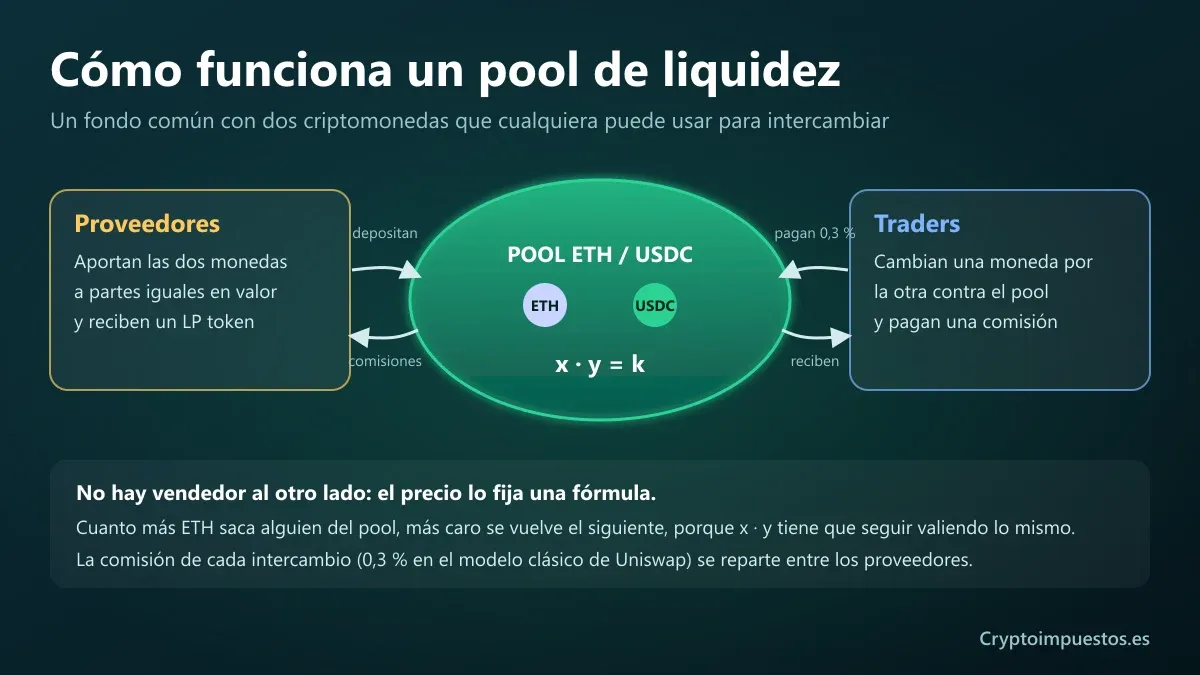
Three pieces worth being clear on:
- You deposit both coins at once, usually 50/50 by value. If you want to join an ETH/USDC pool with $4,000, you put in $2,000 in ETH and $2,000 in USDC.
- You receive an LP token (liquidity provider token). It’s the receipt that proves which share of the pool is yours. To get your funds back, you return it to the contract.
- You earn fees in proportion to your share. In Uniswap’s classic model, every swap pays 0.3%, which is shared among the providers.
 How much can you earn? The APR of a liquidity pool
A pool’s yield is advertised as APR (annual return without reinvesting) or APY (with earnings reinvested, so it always looks bigger). It comes from two sources:
- Trading fees. They depend on volume: a pool with lots of activity and little liquidity pays out more for every euro deposited.
- Token incentives. Many protocols pay an extra in their own token to attract liquidity. This is what’s known as yield farming.
Here’s the first catch. A 200% APR usually comes almost entirely from incentives paid in a token that gets sold the moment it’s collected, and its price falls just as fast. The APR is a snapshot of the recent past, not a promise: it changes every day with volume and with the price of the reward token.
 Impermanent loss: the trap nobody explains
Impermanent loss is what you miss out on by keeping your coins in a pool instead of simply holding them, when the price of one changes relative to the other.
It happens because the pool rebalances itself. If ETH rises, traders buy cheap ETH from the pool until it matches the market price. The result: the pool, and you with it, ends up with less ETH, precisely the asset that was going up, and more USDC.
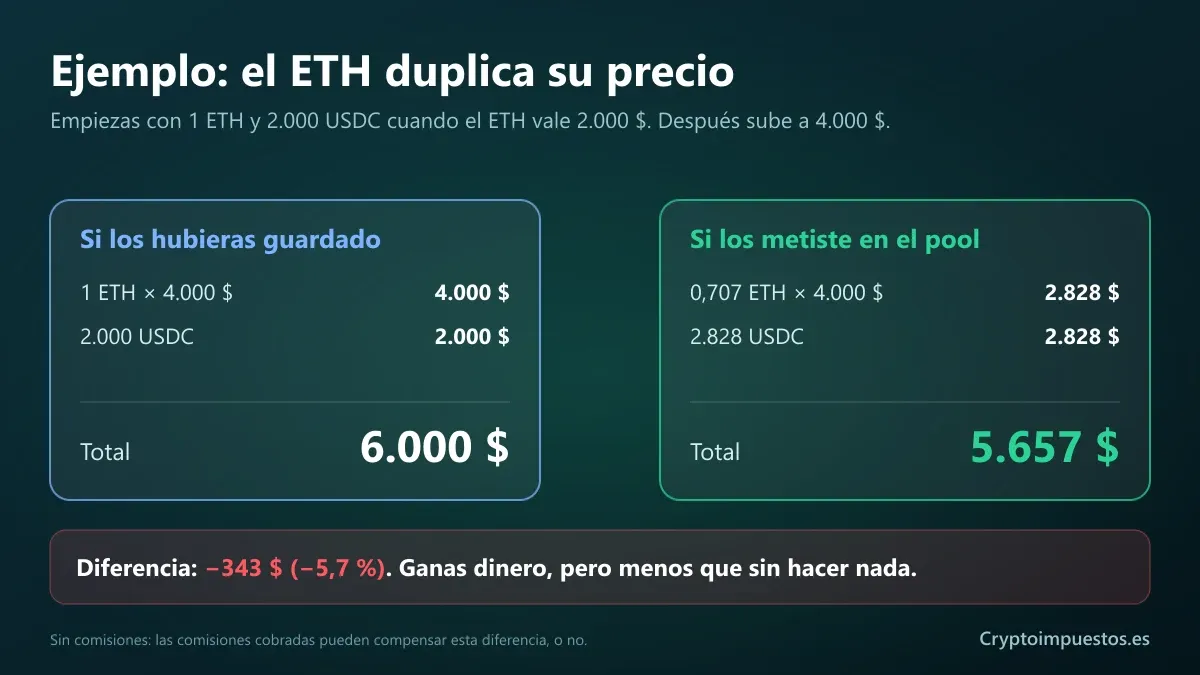
And the price doesn’t have to rise: if it falls, the same happens the other way round. What matters is how far the prices drift apart, not in which direction:
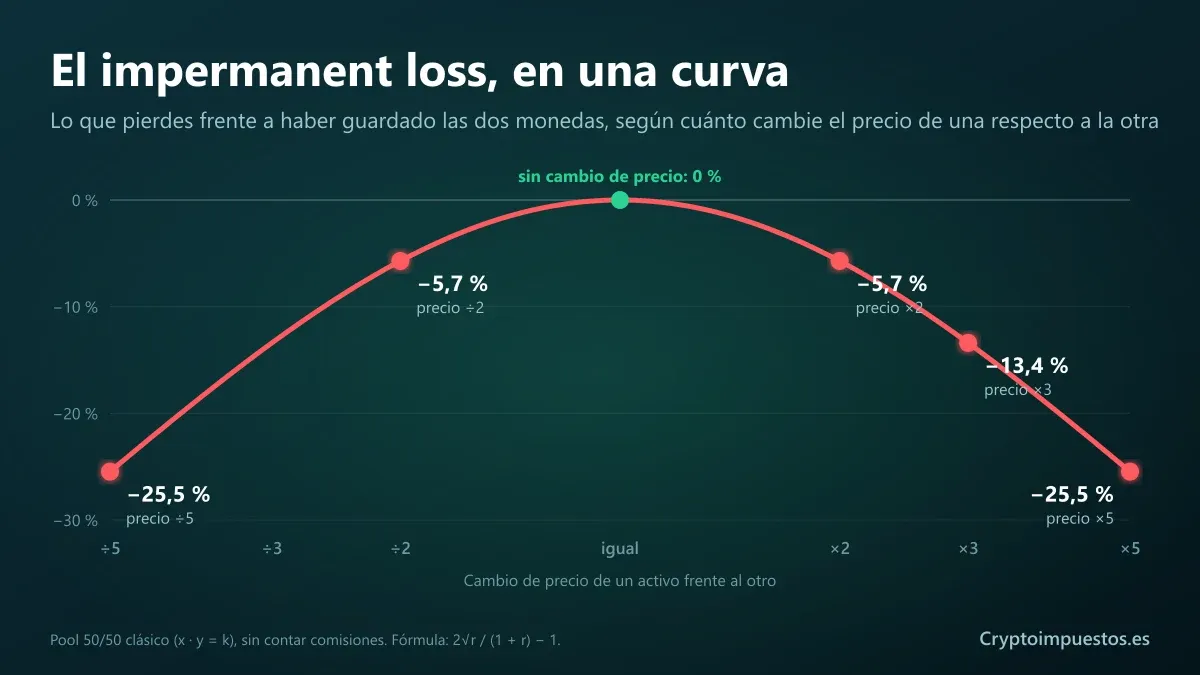
It’s called impermanent because, if prices return to where they started, it disappears. But as soon as you withdraw your funds with the prices apart, it becomes permanent. That’s why pools of two stablecoins, such as USDC/USDT, barely suffer from it: their prices hardly move against each other.
 Other risks: hacks, rug pulls and burnt LP tokens
- Smart contract bugs. If the code has a flaw, the pool’s funds can be drained. There’s no guarantee fund and no one to complain to.
- Rug pull. In pools for new tokens, the creator can suddenly pull the liquidity they put in and leave the token worthless. That’s why you’ll see projects announcing “LP tokens burnt”: they have burnt their LP tokens so that liquidity can never be withdrawn. It reduces the risk but doesn’t remove it: the team may still hold plenty of tokens to sell.
- Depeg. A stablecoin pool is calm until one of the coins loses its peg to the dollar, which the sector calls a depeg. The pool then fills up with the falling coin.
- Concentrated liquidity out of range. If the price leaves the range you chose, you stop earning fees and end up holding a single coin (more on this just below).
Concentrated liquidity pools: more fees, more risk
In a classic pool, your liquidity covers every possible price, from zero to infinity, and most of it is never used. In a concentrated liquidity pool, such as those on Uniswap v3 or Orca’s Whirlpools on Solana, you choose a price range, for example ETH between $3,000 and $5,000. With the same capital you earn far more fees while the price stays inside. But if it leaves the range you stop earning, you end up entirely in the coin that performed worse and the impermanent loss is larger than in a classic pool.
 Where to find liquidity pools: Uniswap, Solana and the rest
| Platform | Network | What it’s known for |
|---|---|---|
| Uniswap | Ethereum and others | The benchmark AMM; popularised concentrated liquidity |
| Curve | Ethereum and others | Stablecoin pools with little impermanent loss |
| Balancer | Ethereum and others | Multi-coin pools and weightings other than 50/50 |
| Orca and Raydium | Solana | Low fees and concentrated liquidity |
| PancakeSwap | BNB Chain | The most used DEX on that network |
Some centralised exchanges have offered similar products, such as the Liquid Swap Binance launched in 2020, but there it’s the platform that holds your funds.
 How are liquidity pools taxed in Spain?
There are three moments, and only one has a clear position from the Spanish tax authorities:
| Moment | Treatment | Is there a DGT ruling? |
|---|---|---|
| Depositing the coins and receiving the LP token | Depends on the interpretation: it may or may not be treated as a swap | No |
| Earning fees and incentives | Investment income, savings tax base | Yes, ruling V0648-24 |
| Withdrawing the funds | Depends on how the deposit was treated | No |
What the DGT (Spain’s Directorate-General for Taxes) has said, in binding ruling V0648-24, is that returns from liquidity pools are investment income (rendimientos del capital mobiliario) and are taxed in the savings tax base, at 19% to 30%. In that same ruling it did not address whether receiving the LP token counts as a swap.
What about impermanent loss? How it affects what you declare when you withdraw depends on the approach applied to the whole cycle, from deposit to withdrawal. There’s no single answer, and a wrong interpretation can make you declare too much or, worse, too little.
That’s why, wherever the tax authorities haven’t given clear guidance, our specialists analyse your activity and give it the right tax treatment for your specific case. If you have liquidity in pools, message us on WhatsApp before you file. In the meantime, keep the date, amounts and euro value of every deposit, payout and withdrawal. You’ll find the other transaction types in our crypto tax glossary, the calculation using the FIFO method, how to offset losses and how staking and rewards are taxed. To keep track, save your addresses and history as we explain in our guide to extracting your wallet activity.
 Quick liquidity pool glossary
| Term | What it means |
|---|---|
| AMM (automated market maker) | The formula that sets the pool’s price |
| LP token | The receipt for your share of the pool |
| Depeg | When a stablecoin loses its peg to the dollar |
| APR / APY | Annual return without reinvesting / with reinvesting |
| Impermanent loss | What you lose compared with holding the coins when their relative price changes |
| Concentrated liquidity | Providing liquidity only within a price range |
| TVL | Total value locked: how much money is in the pool |
| Slippage | The difference between the expected price and the one you get on a large swap |
| Yield farming | Moving liquidity between pools to collect extra incentives |
 Frequently asked questions about liquidity pools
Can you lose money in a liquidity pool?
Yes. Through impermanent loss, a fall in the price of the coins you deposit, a contract bug or a rug pull. Fees can make up for it, but that isn’t guaranteed.
What is the APR in a liquidity pool?
The estimated annual return, without reinvesting, based on the fees and incentives of the last few days. It isn’t fixed: it changes with volume and with the price of the reward token.
What does it mean when LP tokens are burnt?
That the pool’s creator has destroyed their LP tokens and can no longer withdraw that liquidity. It’s a sign of trust against rug pulls, but not a guarantee.
Is a stablecoin pool better?
It suffers far less impermanent loss because the prices barely drift apart, but it also tends to pay less. Its main risk is a depeg: a stablecoin losing its peg to the dollar.
Is providing liquidity to a pool taxable?
The fees are, as investment income. Whether depositing and withdrawing are taxable, and how, hasn’t been clarified by the DGT and depends on each case: that’s exactly what our specialists review.
A liquidity pool isn’t an interest-bearing account: it’s a bet that the fees will pay more than it costs you when prices move. If you’re already in one and don’t know how to declare it, message us on WhatsApp and our specialists will tell you how to treat it. And if you want to get a feel for it first, start with our guide to declaring cryptocurrency in Spain.

Víctor Lázaro
Marketing Director, Cryptoimpuestos.es