In December 2018 Gerald Cotten, founder of QuadrigaCX, Canada’s largest exchange, died in India. His customers found out a month later, and the news came with something worse: nobody else had access to the wallets. More than 76,000 people lost at least 169 million Canadian dollars. Later, the regulator showed it was not even a matter of lost passwords: the money had not been there for a long time.
The short answer: if your exchange goes bust, what you get back depends on whether your crypto was kept separate from the company’s own assets. Under MiCA, exchanges authorised in Europe are required to do so, and in a crypto exchange bankruptcy your coins should not be used to pay other creditors. Without a licence, you are just another creditor in the queue. At CryptoImpuestos we have gone through what the regulation says and what happened in the big collapses so you know where you stand.
 What do you really have when your crypto is on an exchange?
When you buy bitcoin on an exchange, what you see in the app is a balance: an entry saying how much the company owes you. The private keys to those coins are controlled by the company. This is what is called custody.
While everything goes well, the difference goes unnoticed. The problem comes when the company stops paying. Then the question is not what your balance shows, but whether the coins behind it exist and whether they are yours or the company’s. If you want to understand the difference between a balance and a key, start with what a crypto wallet is.
 What happened at QuadrigaCX and FTX?
Two cases that explain it all:
- QuadrigaCX (2019). After its founder’s death, the exchange said it could not access its customers’ crypto. The Ontario Securities Commission’s investigation concluded in 2020 that the collapse was caused by fraud: Cotten had used customers’ money to trade on his own account and covered it with other customers’ deposits, like a Ponzi scheme. Customers had about 215 million in assets and only 46 million were found.
- FTX (2022). One of the world’s largest exchanges collapsed within a week in November 2022 when it emerged that it had lent customers’ money to a company in the same group. Customers became creditors in a US bankruptcy, and their claims were valued in dollars at November 2022 prices, not in the cryptocurrencies they held.
In both cases, the underlying problem was the same: customers’ money and the company’s money were mixed together.
 What does MiCA change if a European exchange goes bust?
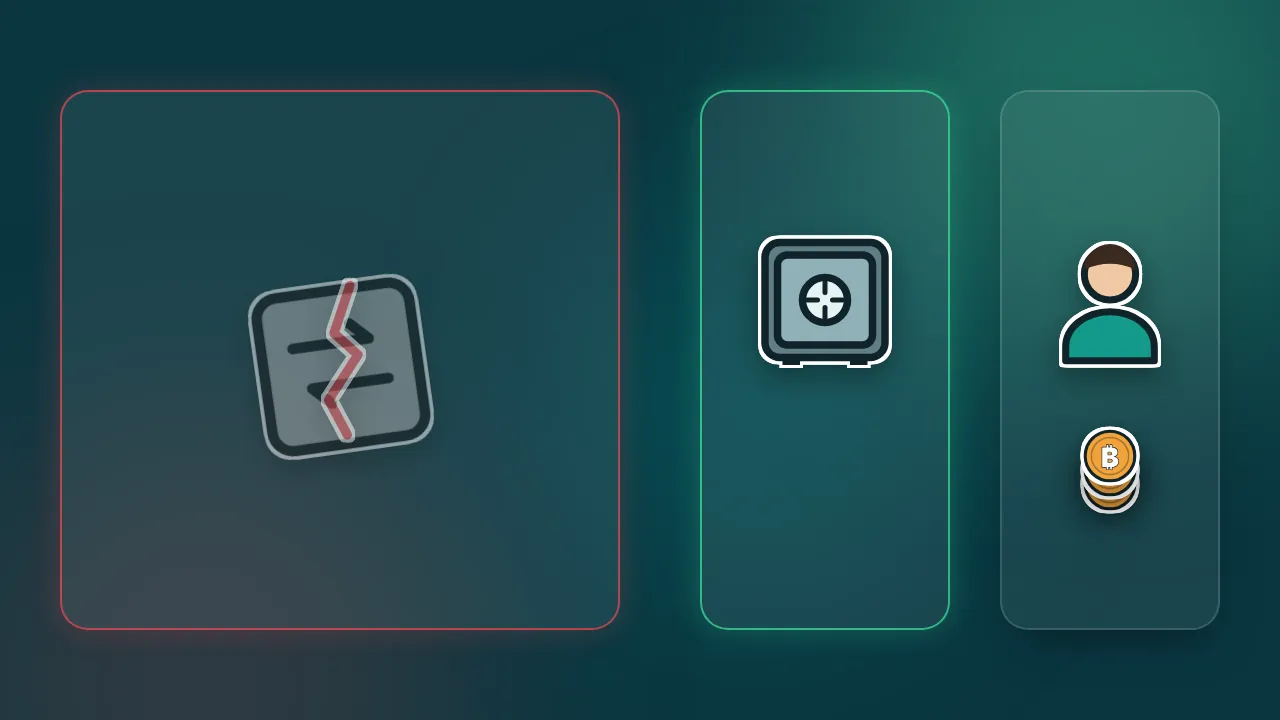
MiCA, the European crypto-asset regulation, tackles exactly that problem. Exchanges authorised in the European Union that hold their customers’ crypto in custody must:
- Protect their customers’ ownership rights, especially in the event of insolvency.
- Keep customers’ crypto separate from their own and keep a record of how much each customer holds.
- Ensure that, if they go bust, that crypto is legally outside their estate, so the company’s creditors cannot be paid with it.
- Be liable to the customer if crypto is lost through an incident attributable to them, such as a hack.
Since July 2026, only exchanges with a MiCA licence can provide services in Spain. On 16 October, ESMA’s register listed 375 authorised providers across the Union, and another list with 178 entries for entities operating without authorisation.
Be careful about what MiCA does not do: there is no fund that gives you your money back, like the Deposit Guarantee Fund for banks. The protection is that your crypto stays yours, not that someone pays you if it disappears.
 The warning signs you should not ignore
Almost no bankruptcy comes without warning. These signs should make you take out at least part of your funds:
- Withdrawals paused or delayed “for maintenance” or “due to high demand”.
- Returns that are too high for leaving your crypto on the platform, with no explanation of where they come from.
- It does not appear in the ESMA or CNMV register, or it appears on the warning lists.
- Sudden changes in terms: new withdrawal fees, limits or notices that it is closing in your country.
- News of problems with the regulator or of executives leaving.
If your exchange announces it is closing in Spain, as happened with CoinEx, act fast: we cover it in CoinEx is closing: what to do with your money.
 What should you do if your exchange stops working?
If it has already happened, the order matters:
- Download your full history now, while you can still log in. When an exchange closes, access to the account is usually the first thing to go, and without the history you cannot prove what you had or what it cost you. You have the guides for downloading it from each platform on our blog.
- Keep evidence: screenshots of your balance, emails from the exchange, notices and terms.
- Try to withdraw what you can, starting with what matters most.
- Complain. If the exchange is licensed in the European Union, first to its customer service and, if it does not answer, to the supervisor. We explain how in how to complain about an exchange to the CNMV.
- If it enters insolvency proceedings, follow the procedure and file your claim on time. It is usually announced by the insolvency administrator or by the exchange itself.
And if someone offers to “recover your funds” in exchange for an upfront payment, that is a second scam. We explain it in what to do if you have been scammed with crypto.
 Can I declare what I do not get back as a loss?
Yes, but not whenever you like. What you lose in an exchange’s bankruptcy is not a sale, so it does not go into the savings base like an ordinary sale. According to the criteria of the DGT (Spain’s Directorate-General for Taxation), it is a capital loss from a debt you do not collect, which goes into the general tax base and can only be declared once the debt is considered uncollectable for tax purposes:
- when a write-down or an agreement reducing what you are owed is approved in the insolvency proceedings, or
- when one year has passed since you started court proceedings other than the insolvency to claim it, without being paid.
Filing a police report is not enough to start that year. And while the insolvency is still open without a write-down, there is no loss to declare yet. If in the meantime you sold other crypto, you declare that as usual. How losses are offset is explained in how to offset crypto losses in your tax return.
Summary: what happens to your crypto if your exchange goes bust
| Situation | What happens to your crypto | What you can do |
|---|---|---|
| Exchange with a MiCA licence | Kept apart from the company’s, outside the bankruptcy | Claim its return in the proceedings |
| Unlicensed or foreign exchange | You may be just another creditor | File your claim and wait for the distribution |
| Crypto in your own wallet | Does not depend on the exchange | Nothing: it is still yours |
| Definitive loss | Capital loss in the general tax base | Declare it once the debt is uncollectable |
 Frequently asked questions
If my exchange goes bust, do I lose my crypto?
Not necessarily. If the exchange has a MiCA licence and met the obligation to keep it separate, it should be returned to you, although the process can take time. If it has no licence or mixed the funds, you may get back only part of it or nothing.
Is there a fund that guarantees my crypto?
No. The Deposit Guarantee Fund covers euro deposits at banks, not cryptocurrencies. MiCA does not create an equivalent fund: it protects your crypto remaining yours, not its value.
How do I know if my exchange has a MiCA licence?
Look it up in ESMA’s register of authorised providers or in the CNMV’s. If it does not appear, or it appears on the warning lists, it cannot offer its services in Spain.
Is it safer to keep my crypto in my own wallet?
Against an exchange’s bankruptcy, yes: if the key is yours, a company going bust does not affect you. In return, the responsibility for keeping your recovery words safe is yours alone.
When do I declare the loss if the insolvency lasts for years?
When the debt is uncollectable for tax purposes: with a write-down approved in the insolvency or one year after starting court proceedings without being paid. In the meantime, keep all the documentation of the process.
Don’t let a bankruptcy leave you without your history too
The first thing you lose when an exchange falls is access to your history, and without it you cannot justify what you had or what you lost. Send us your history and we will produce the document with all your exchanges and wallets using the global FIFO method the Spanish tax agency requires.
Sources: Ontario Securities Commission: QuadrigaCX, A Review by Staff (2020) · Regulation (EU) 2023/1114 (MiCA), articles 70 and 75 · ESMA: interim register of crypto-asset service providers · CoinAlertNews: ESMA’s MiCA register reaches 375 providers (20/10/2026) · Uría Menéndez: DGT rulings on the taxation of crypto-assets

Víctor Lázaro
Marketing Director, Cryptoimpuestos.es