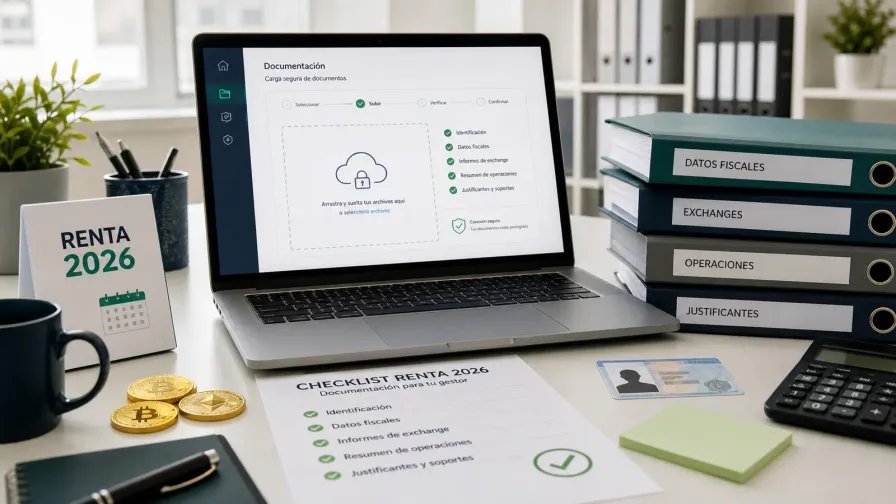
Tax returns do not get stuck on the hard parts. They get stuck on what is missing: the certificate that never arrived, the deed sitting in a drawer, the history of an exchange that no longer exists.
And if you hold crypto, allow more time than you think. Nobody keeps that history for you: you rebuild it yourself, platform by platform.
Below is the full list, block by block, with where each document comes from.
The checklist in 10 points
- Identification and access to the AEAT’s electronic office
- Personal and family details
- Employment: withholding and benefit certificates
- Property: home, mortgage, lettings and sales
- Investment income: accounts, shares, funds and insurance
- Self-employed: income, expenses and record books
- Crypto: full history from every exchange and wallet
- State and regional deductions
- Returns from previous years
- IBAN of an account in your name
Before you start: the Renta calendar
The pattern repeats every year: filing opens online in early April, by phone a month later, in person in the final month, and the campaign closes at the end of June. What changes are the exact days, and the AEAT publishes them campaign by campaign in the Renta campaign calendar, inside the electronic office. Do not take last year’s dates as read.
Reference points from the last closed campaign (2025 tax year, filed in 2026). These are not the dates for the next one:
| Milestone | Reference date |
|---|---|
| Filing opens online (Renta WEB, app and Renta DIRECTA) | 8 April |
| Appointment requests for phone support open | from 29 April |
| Phone support (the Le Llamamos “we call you” service) | 6 May to 30 June |
| Appointment requests for in-person support open | from 29 May |
| In-person support at offices | 1 to 30 June |
| Last day to request an appointment | 29 June |
| Deadline for direct debit of the payment | 25 June |
| End of the campaign | 30 June |
| Second instalment charged, if you split the payment | 5 November |
Two rules that do hold, according to the ministerial order for the reference campaign:
- If you pay by direct debit, your real deadline moves five days earlier than the end of the campaign. If you only direct debit the second instalment, you can file up to the last day.
- You can split the payment interest-free: 60 % when you file and 40 % in early November. It requires filing on time and does not apply to supplementary returns. If the second instalment falls on a weekend, it moves to the next working day.
If you file late and the AEAT has not chased you first, the surcharge is 1 % plus another 1 % for each full month of delay, with no interest and no penalty for the first twelve months; after that, 15 % plus late-payment interest (article 27 of the General Tax Act).
Did you trade in earlier years and not declare it? You do not fix that by putting it in this year’s return. You file a supplementary return for that tax year, with a surcharge but no penalty if you get ahead of the AEAT’s demand. Tell us which years are affected before you file anything.
The information return on virtual currencies has its own deadline, different from and earlier than the Renta. We cover it further down.
Identification and access: the first thing the AEAT asks for
- Electronic certificate or DNIe (the Spanish ID card’s chip) — identifies you and signs without limits across the whole electronic office. It is issued by an accepted certification authority; the DNIe, by the police.
- Cl@ve Móvil — the alternative if you have no certificate installed. With Cl@ve you can do everything without a reference number. Register in advance by video identification.
- Reference number — the quick route if you have neither of the above. It is shown on screen or in the app; it does not arrive by text message.
- Your NIF and the verification data — ordinary DNI: expiry date. Permanent DNI: issue date. NIE: the support number on the card.
- Last year’s return as a PDF — that is where the box figure comes from that completes the request for a reference number.
- IBAN of an account in your name — to receive the refund or set up the direct debit. Check that you are still the holder and that it has not been closed.
- NIF of your spouse and of every member of the family unit with income — required to access the draft return under joint taxation.
The number of that box changes from one campaign to the next. Trust what the official screen asks for, not what you read last year. If you did not file last year, you will be asked for the last five digits of an IBAN you are on record as having held.
Download your tax data, but do not treat it as final. The AEAT itself describes it as “partial information, neither exhaustive nor conclusive”. What is not there may still be yours, and it still has to be declared.
Personal and family details
- Marital status on 31 December — Renta WEB asks about your situation on that date, not the date of the event itself.
- Full marriage certificate, or divorce decree and settlement agreement — they determine the type of family unit and the joint-filing reduction. Civil Registry or the court.
- NIF and date of birth of each child — the minimum allowance for descendants requires them to be under 25, with no age limit where there is a disability of 33 % or more, and the child must not have income above €8,000 a year.
- Decree or agreement setting out custody arrangements — with shared custody, the minimum allowance for descendants is split 50/50.
- NIF, age and income of the dependent ascendant — over 65 or with a disability of 33 %, living with you for at least half the year and with income no higher than €8,000 a year.
- Disability certificate — issued by IMSERSO or by your region’s equivalent body. A pension for total or absolute permanent incapacity, or for severe disability, already certifies the 33 % automatically.
- Valid large-family card and its category — issued and renewed by your autonomous region. Check the expiry date.
- Decree or agreement on compensatory payments or maintenance annuities, with proof of payment and the recipient’s NIF — the compensatory payment reduces your tax base; maintenance annuities are treated differently in the calculation.
Joint or individual? Renta WEB calculates both options and shows you the two results: joint filing only pays off if one of you earns little or nothing. If you both hold crypto, send the histories separately and say whose each account is: under joint filing one person’s losses offset the other’s gains; under individual filing they do not. An exchange account is taxed on its holder, even if the money came from the joint account.
If you are an employee or a pensioner
Almost all of this already reaches the AEAT. The certificate is there to cross-check: if the draft return does not match the certificate, go with the certificate.
- Withholding certificate, one from each payer — evidences what you earned, what was withheld and your social security contributions. Issued by each employer.
- SEPE income tax certificate — unemployment benefit, subsidies and the part of a furlough scheme paid by the SEPE. On the SEPE’s electronic office.
- Social security withholding certificate — pensions and INSS benefits. On the social security electronic office.
- Dismissal letter, itemised final settlement and the conciliation record or court judgment — they set which part of the severance is exempt, capped at €180,000.
- Receipts for trade union and professional association fees — deductible; the professional association only if membership is compulsory for your job, and up to €500 a year.
- Solicitor and court agent invoices for a dispute with your employer — legal defence, deductible up to €300 a year.
- A list of all your payers with the gross amount from each — so you know which filing threshold applies to you.
Fees and legal defence do not appear in the draft return. If you do not enter them yourself, you lose them.
Watch out if you had more than one payer
The threshold below which you are not required to file drops when there is more than one payer. In the last closed campaign: €22,000 with a single payer and €15,876 when the second and subsequent payers add up to more than €1,500 a year as a general rule. These are amounts the AEAT confirms campaign by campaign, and there have been one-off exceptions within a single tax year: check the ones for the year you are filing.
A furlough scheme means two payers. Changing employer, drawing unemployment benefit, or sick leave paid by the INSS or FOGASA also create a second payer.
And if you have sold or swapped crypto at a gain, assume you are filing: that gain carries no withholding and takes you out of the payroll-based exemptions, however small the amount.
Home and property
You need to identify each property and know what it was used for on every day of the year.
- Cadastral reference of each property — it is on the IBI (council tax) bill and on the Cadastre’s electronic office. Parking spaces too.
- The year’s IBI bill — that is where the cadastral value and its split between land and building come from.
- Deed or land registry extract — purchase date, price and share of ownership. Notary or Land Registry.
- Days of each use during the year (empty, let, lent) — they determine how the split between imputed income and rental income is worked out.
- Annual mortgage certificate — capital repaid, interest and linked insurance. Your bank.
- Tenancy agreement, tenant’s NIF and days let — the signing date decides which reduction you apply to the rental income.
- Rental expenses — IBI, service charges, insurance, utilities you pay, repairs and legal defence. Deductible only for the period it was let.
- Purchase deed with notary, registry and taxes, plus furniture invoices — the basis of the deductible depreciation: 3 % a year on the higher of acquisition cost and cadastral value, excluding land. Furniture included in the let is depreciated item by item, using the coefficient from the simplified table.
- If you sold: purchase and sale deeds, invoices for improvements, costs and taxes on both, and the depreciation applied — that is what the acquisition and transfer values are built from. Repairs do not count; improvements do.
- Deed of the new main home, if you are reinvesting — the reinvestment exemption requires you to reinvest within two years and to claim it in the return: it is not applied automatically.
Urban properties at your disposal generate imputed income on the cadastral value, with no expenses deducted; your main home imputes nothing. The percentage depends on whether your municipality has had a cadastral revision: confirm it for the current campaign. And the deduction for investment in a main home was abolished on 1 January 2013: it only survives if you bought before then and were already claiming it. Keep that old return, it is your evidence.
Accounts, shares, funds and insurance
Ask each institution for an annual certificate. One per bank, broker, fund manager and insurer.
- Certificate of interest on accounts and deposits — gross amount and withholding. Your bank.
- Certificate of dividends and withholdings — gross dividend and withholding. Bank or broker. Administration and custody fees on tradable securities are deductible; discretionary portfolio management fees are not.
- Certificate of share purchases and sales — acquisition date and value, transfer date and value, and the commissions on both. Broker or custodian.
- Fund certificate and transfer history — transfers between funds are not taxed and keep their acquisition value and date; ETFs fall outside that regime. From the fund manager.
- Certificate of pension plan contributions — separating your own contributions from your employer’s. Fund manager or insurer.
- Certificate for life insurance, unit-linked policies, PIAS and life annuities — return and withholding. Insurer.
- Certificate for Treasury bills, bonds and debentures — amounts and dates of acquisition and of redemption or sale.
What the draft return gets right: interest, dividends and the year’s withholdings. What it gets wrong: acquisition values of old shares, transfers between institutions, foreign brokers and Treasury bills bought directly. That part is on you.
If you are self-employed
This section covers the simple case: simplified direct assessment, no employees and no company. If you were registered as self-employed for even a month, you are required to file whatever your profit.
- Record books for the full tax year — sales and income, purchases and expenses, capital assets. From your invoicing software or your accountant.
- Invoices issued and received — a bank statement is not an invoice.
- The year’s four Modelo 130 filings — the instalment payments already made are deducted from your bill. On the AEAT’s electronic office.
- The four Modelo 303 filings and the Modelo 390 — so your income and expenses tie in with what you declared for VAT.
- Modelo 111 and 190, plus 115 and 180 if you rent premises — evidence of the withholdings you applied.
- Withholding certificates from your clients — they are required to issue them before the Renta filing period opens.
- Report of social security contributions paid — bases and contributions actually paid. Request it on Importass.
- Utility invoices with the square metres of your office — if part of your home is assigned to the business, you deduct 30 % of the ratio between the assigned area and the total.
- Meal invoices with your tax details and the card statement — hospitality only, paid electronically and within the subsistence limits. Cash does not count.
- Records and invoices for capital assets — they support your depreciation.
The hard-to-evidence expense under simplified direct assessment is 5 % of the positive net profit, capped at €2,000 a year, and needs no invoice.
This is no longer the simple case, so talk to us: you have employees, you also use the car privately, you have received an adjustment of your self-employed contributions, you are taxed under the modules regime, or you exceeded €600,000 of turnover the previous year.
Crypto: the paperwork nobody tells you about
Your tax data does not include your crypto transactions. Confirming the draft return in two clicks and seeing nothing about crypto does not mean you have nothing to declare: not obtaining the draft return or the tax data does not release you from the obligation to file.
Which transactions are taxed and which are not
| Transaction | How it is taxed | Which base |
|---|---|---|
| Selling crypto for euros | Capital gain or loss: transfer value less acquisition value, including directly related costs | Savings base |
| Swapping crypto for crypto (including moving into a stablecoin) | Capital gain or loss, taken as the higher of the market value of the coin given up and the one received | Savings base |
| Paying for goods or services with crypto | There is a transfer and therefore a change in your assets (article 33.1 of the Income Tax Act) | Savings base |
| Moving between your own wallets or exchanges | There is no change in the composition of your assets. You have to be able to prove it | Not applicable |
| Staking, lending and rewards | The Directorate-General for Taxation has been treating these as investment income, at the euro value on the day received | Savings base |
| Airdrops and bounties | Administrative criterion: a capital gain not arising from a transfer. No binding ruling published | General base |
| Mining | It has been treated as an economic activity, with its own registration obligations | General base |
Sales, swaps and the FIFO criterion are set out expressly in the AEAT’s practical income tax manual. The other cases are not developed there and rest on criteria from the Directorate-General for Taxation: which is exactly why they should be documented transaction by transaction.
Crypto-for-crypto swaps are the costliest mistake. Swapping bitcoin for ether, or any coin for a stablecoin, produces a gain or a loss even if you never touch a euro and never take anything off the exchange. If you have made a hundred swaps, you have a hundred transactions to calculate. We go into it in how to declare crypto in Spain.
NFTs have their own, different set of scenarios. If you have traded them, check with an adviser.
The crypto checklist
- Full transaction history from every exchange — the basis of any calculation. In your account area: “Export history”, “Tax report” or “Transaction history”. As native CSV, not PDF and not screenshots.
- History from exchanges you no longer use or that have shut down — the obligation does not lapse because you left the platform. If you still have the account, log in and export; if you closed it, ask support or the insolvency administrator. There is a guide in how to export the history from each exchange.
- Public addresses of all your self-custody wallets — xpub or a list of addresses. They allow the on-chain movements to be reconstructed. We explain it in the guide to extracting wallet activity.
- A list of the networks you have used — Ethereum, BSC, Solana, Arbitrum and the rest. Each network has its own explorer and its own fees; forget one and transactions go missing.
- Date, time and euro value of each transaction — the AEAT calculates in euros, not in dollars and not in USDT. If your exchange exports in USD, you need the exchange rate for that date.
- Fees on each transaction — trading, withdrawal and gas fees. They add to the acquisition value or subtract from the transfer value, and that reduces your gain.
- Balance of each coin on 31 December, on each exchange and in each wallet — in units and in euros, noting which price source you used. It is needed for the Modelo 721, for wealth tax and to reconcile the history.
- Evidence of transfers between your own wallets — transaction hash, source address and destination address. Without this, a transfer from your exchange to your hardware wallet reads as an undeclared sale.
- Bank records of money in and out of the exchange — they show where the money you bought with came from.
- Breakdown of staking, rewards, lending, airdrops and payments made in crypto — date, amount and euro value on the day. Each is taxed differently; the detail is in how staking and rewards are taxed.
- Losses from previous years still available to offset — a copy of the earlier returns or the breakdown of balances. If you do not declare them, they expire.
- Origin of any crypto you did not buy — if you inherited it, your acquisition value and date are the ones declared for inheritance tax: send the deed and that self-assessment. If it was gifted to you, the value comes from gift tax, and whoever gifted it also has a capital gain on their own return.
If an exchange shut down and there is no way to recover the history, do not leave it out and do not put the acquisition value at zero: that would give you an inflated gain. Gather whatever you have (confirmation emails, bank statements, withdrawal hashes) and tell us.
Why you need the full history, not just this year’s
When you sell part of a coin you bought at different times, you are treated as selling the earliest ones first: that is the FIFO criterion. In its practical manual the AEAT treats crypto of the same type as homogeneous assets, and the criterion applies across all your holdings, not exchange by exchange: all your BTC form a single pool wherever they are.
So to calculate this year’s sale you need the history from your very first purchase, even if that was eight years ago. A CSV from 2017 may still be needed ten years from now. We go into it in depth in the FIFO method applied to crypto.
Losses and offsetting
If you still have capital losses after offsetting them against your gains, you can offset them against the positive balance of investment income, capped at 25 % of that balance, and vice versa. Any remaining negative balance is offset over the following four years. We set it out in how to offset crypto losses on your tax return.
If the year came out negative, file anyway: the loss is only carried forward for the following four years if you include it in the return for the year it arose. And be careful: an exchange going bust or your being scammed is not an automatically deductible loss. Until the debt is legally irrecoverable it cannot be counted.
The Modelo 721 and other obligations that are not the Renta
| Form | Who files it | Threshold | Deadline |
|---|---|---|---|
| 721 — virtual currencies held abroad | You: holders, beneficiaries, authorised persons and beneficial owners of crypto held by a third party | €50,000 in combined balances on 31 December | 1 January to 31 March of the following year |
| 172 — balances in virtual currencies | The company, not you: whoever holds private keys on behalf of third parties | No threshold | January of the following year |
| 173 — transactions in virtual currencies | The company, not you: exchanges and intermediaries | No threshold | January of the following year |
| 714 — wealth tax | You, if you exceed the thresholds | Tax payable, or assets and rights above €2,000,000 | The same as the Renta |
Sources: frequently asked questions on the Modelo 721 and filing deadlines.
Exchanges reporting does not release you from filing. And in later years you only have to file the 721 again if the combined balance rises by more than €20,000 against the one behind your last filing, with one exception: you must always file for any coins over which you ceased to be the holder or authorised person during the year. The details are in the guide to the Modelo 721.
The €50,000 threshold is a combined one and is measured on 31 December, not at the year’s price peak. And its deadline does not coincide with the Renta: it is filed earlier.
What the AEAT already knows about your crypto
Spanish providers report your balances and transactions with no minimum threshold. The guidelines of the 2026 Annual Tax and Customs Control Plan announce “monitoring action on taxpayers who, having traded in this type of asset, have not declared income or capital gains”. In practical terms: your return can be cross-checked against data already in their hands. We go into it in has the AEAT detected my Binance transactions?.
If you receive a proposed assessment or a formal demand, the window to reply is short. Do not answer and do not sign your agreement without showing it to us: send us the complete PDF with the file number and the notification date.
Documents so you do not lose deductions
- Donation certificate from the organisation — the only valid evidence. It must include the NIF of both parties, a reference to Act 49/2002, the date, the amount and the fact that it is irrevocable. Add up the two previous years: repeat giving raises the percentage.
- Annual certificate of political party fees — a 20 % deduction, on a maximum base of €600 a year.
- Tenancy agreement signed before 1 January 2015 — the state deduction for renting only survives under transitional rules for agreements predating that date. Keep receipts and the landlord’s NIF.
- Invoices from an authorised nursery — the childcare increase goes up to an extra €1,000 a year. Check that the Modelo 233 appears in your tax data; the nursery files it.
- Both energy efficiency certificates, before and after the works — plus invoices and proof of bank payment: cash gives no entitlement to the deduction.
- Invoice for the electric vehicle and its registration document, or the invoice for the charging point — a 15 % deduction, with no cash payments. Add the MOVES grant award: whatever is subsidised is taken off the base.
- Certificate of contributions to your spouse’s pension plan — an additional reduction of up to €1,000 a year if your spouse’s net income is below €8,000.
Regional deductions
Before the region, settle the country: you are a Spanish tax resident if you spend more than 183 days here or your centre of economic interests is here, and in that case you also declare what is outside Spain, crypto included. If you left or arrived mid-year, or you are under the inbound expatriate regime, tell us before sending anything: it changes the entire tax calculation.
The regional deductions that apply to you are those of the region where you have your habitual residence, and that residence is decided by where you spent the most days of the year, not by your town-hall registration or where your payroll is. Each region changes its own every year, so we give no figures here: check the AEAT’s guide to regional deductions for the year you are filing.
Always keep these, whether or not they help this year: town-hall registration with dates, the tenancy agreement with proof of the deposit, invoices in your name for school or school supplies, the family book, and disability or dependency certificates.
Common mistakes that cost money
- Exporting only the last year’s CSV. Without the original purchases there is no acquisition value, and the gain is calculated on almost the whole sale amount.
- Forgetting a wallet, an old account or an exchange that shut down. It breaks the FIFO chain and throws off the whole calculation.
- Sending screenshots instead of files. They cannot be processed: no reliable timestamp, no fees and no pairs.
- Filtering out what you think “are not sales”. Swaps, staking, airdrops and network fees each have their own treatment; take them out and half the return is missing.
- Not providing the withholding certificate from the second payer. It changes both your obligation to file and the result.
- Confusing a fund transfer with a redemption. Declare a transfer as a sale and you overpay; the other way round and you get a parallel assessment.
- Not flagging losses still available to offset. They expire, and the saving with them.
- Paying in cash where bank payment is required. Energy efficiency and charging points lose the deduction even if you have the invoice.
- Sending files without saying whose they are. A “certificate.pdf” within a family unit means another round of emails.
- Assuming the draft return already has everything. It does not have your crypto, your regional deductions or your family circumstances for the year.
How to send it to us
Send it in a single ZIP: one folder per person and one file per platform, named NAME_PLATFORM_YEAR.csv. Native CSV exactly as the exchange gives it to you: opening and saving it in Excel breaks the dates and the decimals. If it is over 25 MB, upload it to a download link and send us the link.
Keep every piece of evidence for as long as the AEAT can review that tax year; check the limitation period in force before throwing anything away. With crypto the rule is different: the history is kept from the first acquisition, because FIFO forces you to carry the original purchase value through to the day you sell those coins.
Frequently asked questions
Do I have to declare crypto if I have not sold anything?
If you have only bought and held, there is no capital gain to declare. But crypto-to-crypto swaps are transfers even if you never pass through euros, and staking or airdrops generate income even if you do not sell. On top of that, your balances on 31 December may oblige you to file the Modelo 721 or wealth tax.
What documents does the exchange have to give me?
The full transaction history from day one, in CSV, and the tax report if it produces one. You need the date, transaction type, amount, euro value and fees on every line, plus the balance of each coin on 31 December. The exchange’s report is not enough on its own: it does not know about your transactions on other platforms.
How do I declare it if I swapped bitcoin for another crypto without going through euros?
As a capital gain or loss in the savings base, valued at the higher of the market value of the coin you give up and the one you receive. Not having received euros changes nothing.
What happens if the AEAT already knows I hold crypto and I do not declare it?
Spanish exchanges report your balances and transactions with no minimum threshold, and the 2026 Annual Tax Control Plan announces specific action on anyone who has traded and not declared. What usually arrives is a proposed assessment or a formal demand. Declaring properly comes out cheaper than answering afterwards.
Does the AEAT’s tax data already include everything?
No. The AEAT defines it as partial and non-exhaustive information, and not obtaining it does not release you from filing. Review the draft return and amend it if data is missing: crypto in particular does not appear there.
And if I have transactions from previous years that were never declared?
They are regularised with a supplementary return for each affected tax year, not by putting them in this year’s return. If you get ahead of the demand there is a surcharge but no penalty. You can see it in how to regularise crypto from previous years.
If you would rather not do it alone
At CryptoImpuestos we prepare the profit and loss report on a FIFO basis, bringing together all your exchanges and wallets, the Modelo 721 and the crypto part of the Modelo 100, and we respond to AEAT demands. You can see the detail on our crypto tax return service or message us on WhatsApp with your particular case.
This content is for information only and does not constitute personal tax advice.

Víctor Lázaro
Tax adviser, Cryptoimpuestos.es