
During the 2025 income tax campaign, the AEAT (Spanish tax agency) included 1,243,000 notices about virtual currencies in taxpayers’ tax data. If you have traded on an exchange based in Spain, there is a good chance one of them had your name on it. And if you did not get one while doing your tax return, it may still arrive later, by post or in the AEAT’s online tax office (sede electrónica).
It is one of the questions we hear most often at Cryptoimpuestos: “I’ve received this from the tax agency, what do I do?” The short answer: a notice is not a fine, but not every communication from the tax agency is the same, and what you need to do depends on which one you have. In this guide we explain how to identify it, what deadline you have and the seven steps to resolve it properly.
What exactly is a notice from the tax agency?
A notice is an informational communication. The tax agency is telling you that it holds data about you (in this case, about your crypto) and inviting you to check that your tax return reflects it. It does not demand any money and it does not open any procedure.
The AEAT itself sends them at three points:
- Before you file, as part of your tax data (datos fiscales).
- While you are preparing your return, as warnings in Renta WEB (the AEAT’s online income tax return tool) when something is missing or does not add up.
- After you have filed it, by letter, in Renta WEB or in the app.
Where does that data come from? Exchanges based in Spain report your balances as at 31 December (Modelo 172) and your transactions for the year (Modelo 173) to the tax agency. From 2026, the DAC8 directive extends that obligation to European providers; the first data will be exchanged in 2027. We cover this in how the tax agency detects your transactions.
What about CR2, CR3 or CR30001 notices?
There is a lot of talk about “CR notices”. They are the codes Renta WEB uses to flag the information on virtual currencies that the tax agency has received from third parties, mainly through Modelos 172 and 173. They usually come with the list of transactions the exchange has attributed to you.
What matters is what they are not. The AEAT does not describe them as a ladder of warnings or as the step before an inspection, and they are not a penalty either. They are tax data: you need to review them and declare your actual activity, which may differ from what appears there.
Identify what you have received
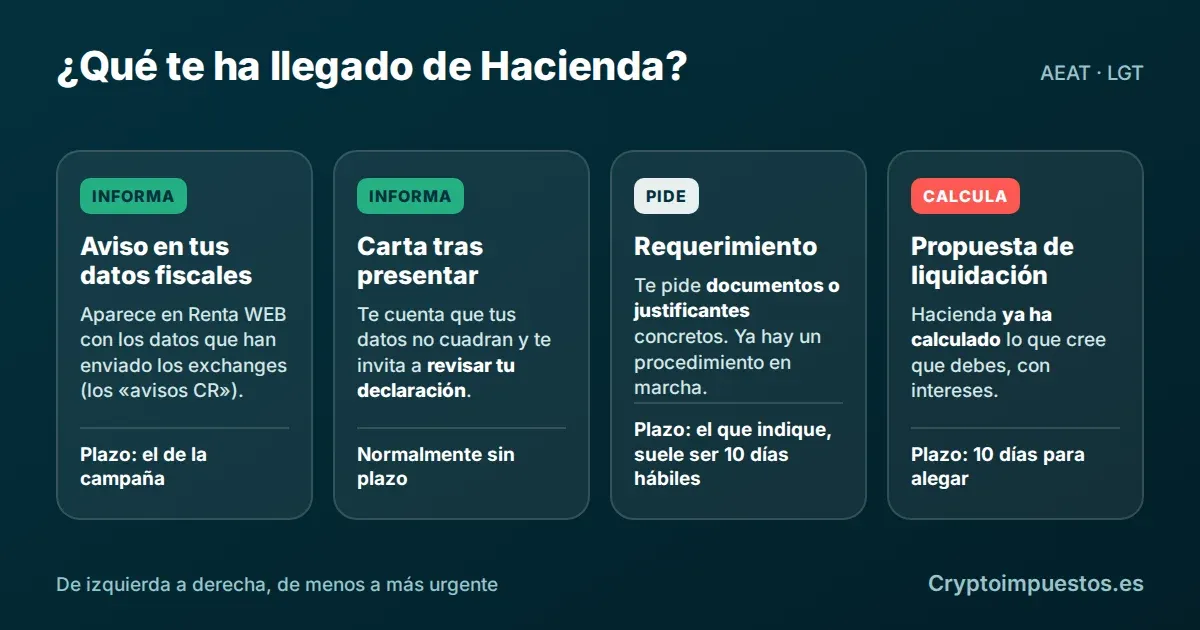
First of all, work out what you are looking at. The deadline, what you need to do and what it could cost you all depend on it.
| What you have received | How to recognise it | Deadline | What it means |
|---|---|---|---|
| Notice in your tax data (the “CR” notices) | Appears when you check your tax data or prepare your income tax return | The income tax campaign deadline | Informational: review and declare correctly |
| Letter or notice after filing | Tells you about data that does not match your return and invites you to review it | Normally sets no deadline | Informational, as long as it does not open a procedure |
| Request for information | Asks you for specific documents or supporting evidence | Whatever it states; usually 10 working days | A procedure is already under way: reply on time |
| Proposed assessment | Includes tax calculated by the tax agency and a period to submit objections | 10 days to object | The tax agency has already done its calculation |
| Provisional assessment | A decision with an amount to pay | 1 month to appeal | Pay or appeal |
What to do when you receive a notice from the tax agency: step by step
Step 1: check that it is genuine
Scams impersonating the tax agency are common, and crypto investors are an obvious target. Before anything else:
- Official documents carry a secure verification code (código seguro de verificación, CSV) that you can verify in the AEAT’s online tax office.
- The tax agency will never ask for your card details or ask you to pay through a link in a text message or email.
- Go to the online tax office yourself, never through the link in the message.
Step 2: identify the type and note down the deadline
Use the table above. If it is a request for information or a proposed assessment, the clock is already ticking: write the deadline down on day one.
Be careful with electronic notifications. If you are required to receive them or you signed up for them, a notification is deemed served once 10 calendar days have passed without you opening it. Not opening it does not stop the clock.
Step 3: see what data the tax agency holds
In Renta WEB, check your tax data for the year the notice refers to: there you will see the balances and transactions attributed to you. Also review the notifications in the online tax office. If you would rather we look at it for you, we will need your AEAT reference number.
Step 4: gather your full history
The year of the notice is not enough. The tax agency requires the FIFO method, so the cost of what you sold depends on purchases that may be years old. We explain this in why you need to declare every year.
Download the history from every platform you have used:
If you are asked for an API key, make sure it is read-only: we explain why it is safe to share one.
Step 5: cross-check your data against the tax agency’s
What appears in the notice is not necessarily what you owe. There are documented cases of duplicated transactions, transfers between your own accounts counted as sales and transactions wrongly classified as swaps.
And the other way round: if something does not appear, that does not mean you do not have to declare it. Exchanges not based in Spain and your own wallets are not covered by Modelos 172 and 173.
Step 6: calculate and decide how to regularise
With your full history, calculate your gains and losses using FIFO. Remember that losses can be offset against gains, including those from previous years.
Then decide based on what you have received:
- If it was an informational notice and you have already filed your income tax return without your crypto, you need a amended return.
- If it is a request for information, reply on time with the documentation and your calculation.
- If it is a proposed assessment, review the tax agency’s calculation and submit objections if it is not correct.
Also check whether you needed to file Modelo 721, the information return for crypto held in custody abroad when it exceeds €50,000 as at 31 December.
Step 7: contact us before you file anything
It is the last step, and the one that prevents mistakes in all the others. At Cryptoimpuestos:
- We review the communication you have received and tell you what it is and what deadline applies.
- We rebuild your activity across all your exchanges and wallets, from your first transaction.
- We calculate your gains and losses using FIFO and cross-check the result against the tax agency’s data.
- We prepare the amended return, the reply to the request or the objections, with a report reviewed and signed by a professional.
The sooner you get in touch, the more room you have: the deadlines for a request for information are short and the surcharge on an amended return goes up every month. Message us on WhatsApp.
How much does it cost to regularise sooner or later?
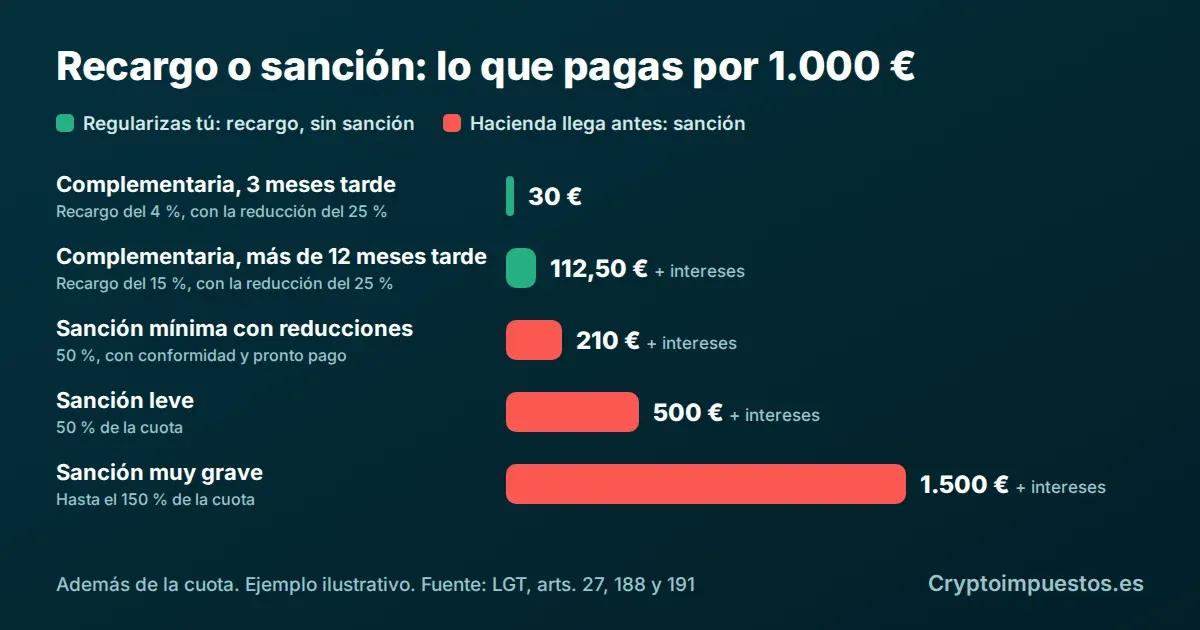
If you get in first. As long as the tax agency has not started a procedure with you for that tax and that year, the amended return counts as filed without a prior request. There is no penalty: you pay a surcharge of 1% plus 1% for each full month of delay, rising to 15% plus late-payment interest if more than 12 months have passed. If you pay at the same time as you file, the surcharge is reduced by 25%.
If the tax agency gets there first. What you receive is an assessment with late-payment interest and, if it finds an infringement, a penalty: at least 50% of the amount you failed to pay and up to 150% in the most serious cases. It is reduced by 30% if you accept it and by a further 40% if you pay on time without appealing.
On €1,000 of tax due, the difference looks like this:
The detail of each infringement is in penalties for not declaring crypto.
Which years can the tax agency review?
The tax agency has 4 years to review each return, counted from the end of its filing period. As things stand, the income tax returns for 2022, 2023, 2024 and 2025 are still open. The 2021 return became time-barred on 30 June 2026, unless the tax agency interrupted the limitation period with some action.
If you did not declare in several of those years, we explain what to do in I didn’t declare my crypto: how to catch up.
Summary
| Situation | Consequence | What to do |
|---|---|---|
| Notice in your tax data (CR) | None, if you declare correctly | Review the data and declare your actual activity |
| Informational letter after filing | None yet | Review; if something is missing, amended return with surcharge |
| You did not declare and nothing has arrived | Surcharge of 1% to 15%, no penalty | Regularise as soon as possible |
| Request for information | Procedure open | Reply on time with your history and your calculation |
| Proposed assessment | Tax, interest and a possible penalty of 50% to 150% | Review the calculation and object within 10 days |
| Provisional assessment | Amount to pay | Pay or appeal within 1 month |
Frequently asked questions
Is a notice from the tax agency a fine?
No. It is informational: it tells you what data the tax agency holds. A penalty can only come later, within a procedure.
Do I have to reply to a notice?
You do not need to reply to an informational notice, but you do need to review your return and correct it if something is missing. A request for information or a proposed assessment does need a reply, and on time.
I’ve received a notice. Can I still file an amended return without a penalty?
If the notice only informs you and does not open any procedure, yes: you pay the surcharge, not a penalty. If what you have received is a request for information or a proposed assessment for that tax and that year, the regularisation now goes through that procedure. If you are not sure which case you are in, have a professional review it before you file anything.
What if the data in the notice is wrong?
Do not simply accept it. Declare your actual activity, calculated from your full history, and keep the documentation that proves it.
Does the tax agency know what I hold in a cold wallet?
If the funds left an exchange where you verified your identity, the trail starts there. We explain it in how the tax agency knows I have a cold wallet.
Received something from the tax agency and not sure what it is?
At Cryptoimpuestos we review what you have received, tell you what it is and what deadline you have, rebuild your activity and prepare your amended return or your reply to the tax agency, with a report reviewed and signed by a professional. The sooner we look at it, the more options you have.
Message us on WhatsApp, tell us what you have received and we will tell you what you need, with no obligation.

Víctor Lázaro
Marketing Director, Cryptoimpuestos.es