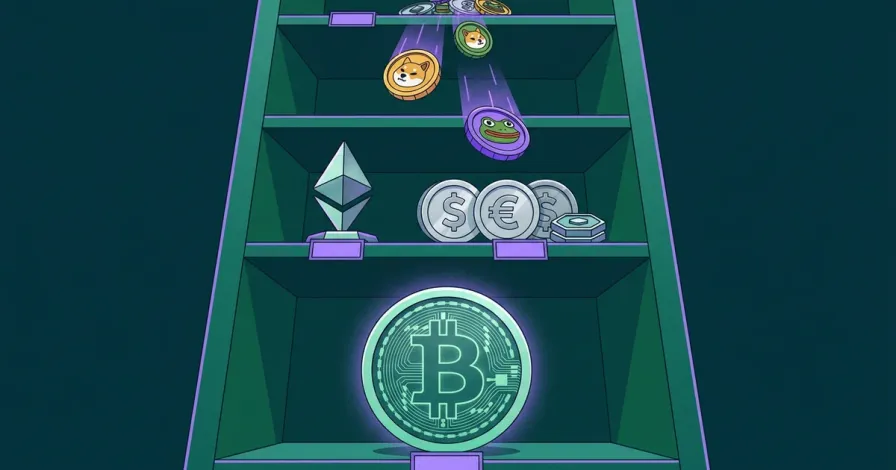
There are more than 22,000 cryptocurrencies on price websites. If you count every token created each day, there are millions. And almost no beginner knows that buying bitcoin and buying this week’s trendy coin are about as alike as buying a house and a scratch card.
The short answer: the types of cryptocurrencies are told apart by what they are for. Bitcoin is scarce digital money, Ethereum is a platform for building applications, stablecoins copy the value of the dollar or the euro and memecoins are joke coins that almost always end up worth nothing. At CryptoImpuestos we explain it from scratch, with data and no promises, so you know what you are looking at before you buy anything.
 How many cryptocurrencies are there and which ones matter?
According to CoinGecko, on 19 October 2026 there were 22,340 active cryptocurrencies. But the market is not shared out equally, far from it:
- Bitcoin takes 60.1% of the value of the whole market.
- The top ten add up to 91.6%.
- The other 22,000-plus share a little over 8%.
Think of it as a cake: bitcoin eats more than half, nine coins share almost all the rest and thousands fight over the crumbs.
 Bitcoin: digital money nobody can print
Bitcoin was born in 2009 with a specific idea: digital money that works without banks or governments in the middle. Its best-known rule is written into the code: there will never be more than 21 million. Nobody can create more, not even those who maintain it.
It is used to store value and to send money anywhere in the world without asking permission. It is not used for much else, and that is on purpose: the simpler it is, the harder it is to break. That is why it is usually the entry point for beginners.
 Ethereum and platforms: programs that run on their own
Ethereum appeared in 2015 with another ambition: not to be just money, but a world computer where anyone can build programs. Those programs are called smart contracts: they do what their rules say without anyone having to approve it.
Decentralised exchanges, peer-to-peer lending and liquidity pools run on Ethereum and its competitors, such as Solana. Its coin, ether, is used to pay the “fuel” for each transaction on the network.
 Stablecoins: cryptocurrencies that do not want to move
A stablecoin is designed to always be worth the same as something else, almost always a dollar or a euro. The best known are USDT and USDC. They are used to step out of volatility without going back to the bank and to move money between platforms.
In Europe, MiCA requires their issuers to hold a licence, and exchanges have until early January to drop those that do not. We cover it in stablecoins and MiCA: what happens to your USDT.
 Memecoins: most of them end up worth nothing
Memecoins are joke coins, usually featuring a dog, a frog or a famous character. Anyone can create one in minutes without knowing how to code. Together they do not reach 2% of the market, but they take a good share of the headlines and of the losses.
The data is harsh:
- Market surveillance firm Solidus Labs analysed in 2025 the tokens launched on pump.fun, the largest memecoin factory, and concluded that around 98% showed signs of fraud: someone pumps them and then sells all at once.
- According to CoinGecko, in 2025 alone more than 11 million tokens stopped trading.
- The most notorious case was LIBRA, in February 2025. It was promoted by the president of Argentina, lost more than 90% in hours and, according to blockchain analysis, a handful of wallets took out more than 100 million dollars.
If someone has sold you a coin with the promise of multiplying your money, read what to do if you have been scammed with crypto first.
 And the rest? Platform tokens and privacy coins
In between there are other families worth recognising:
- Platform or utility tokens. They give discounts, voting rights or access to a specific service, such as an exchange’s token. Their value depends on that service working.
- Privacy coins, such as Monero or Zcash. They hide who sends, who receives or how much. That is why European exchanges have been delisting them, and the new European anti-money laundering regulation bars platforms from dealing with them from July 2027.
 How do you tell a serious cryptocurrency from a trap?
You do not need to be an expert. Look at three things before buying:
- How many years it has been running. A network that has survived several market crashes has a story to tell. One that came out last week does not.
- What it is for, beyond going up in price. If nobody can explain what it does without talking about how much it will be worth, that is a bad sign.
- Who holds the coins. If a few wallets hold almost everything, they can sell all at once and sink the price. That information is public on the blockchain and on price websites.
And a rule that always applies: if they sell it to you with promises of getting rich, be suspicious.
 Are all types of cryptocurrencies taxed the same?
Yes. For the Spanish tax agency it does not matter whether it is bitcoin, a stablecoin or a memecoin: they are all cryptocurrencies and follow the same rules.
- Buying with euros and holding is not taxed.
- Selling it, swapping it for another one or paying with it is. Swapping a memecoin for USDT, or bitcoin for ether, is an exchange and generates a gain or a loss, even if you never see a euro.
- Losses count when you sell or swap. A memecoin that has crashed but that you still hold does not yet generate a loss in your tax return. When you sell it, it does, and you can offset it. We explain it in how to offset crypto losses.
Every transaction in every type of coin goes into your history. If you want to understand how each one is taxed, you have the crypto tax glossary.
Summary: the types of cryptocurrencies at a glance
| Type | Examples | What it is for | Main risk |
|---|---|---|---|
| Bitcoin | BTC | Scarce digital money, 21 million at most | Price volatility |
| Platforms | Ethereum, Solana | Building applications and smart contracts | Technical failures and competition |
| Stablecoins | USDT, USDC | Keeping the value of the dollar or the euro | The issuer not holding the reserves |
| Utility tokens | Exchange tokens | Discounts, votes or access to a service | The service stopping working |
| Memecoins | Joke coins | Speculation | Almost all end up worth nothing |
| Privacy | Monero, Zcash | Hiding transaction data | Delisting from European exchanges |
 Frequently asked questions
What is an altcoin?
Any cryptocurrency that is not bitcoin. The term lumps Ethereum together with the latest memecoin, which is why it says little on its own.
Which is the safest cryptocurrency?
None is safe in the sense that it cannot fall. Bitcoin is the one that has been running the longest and the largest, but its price can drop sharply. Stablecoins are the most stable, although they depend on their issuer really holding the reserves.
Are memecoins illegal?
Not in themselves. Creating one or buying it is not a crime. What can be is pumping it with false information to sell to others, which is what happens in many cases.
Do I have to declare a memecoin that has lost almost all its value?
While you hold it, there is nothing to declare for it in income tax. If you sell it or swap it, you declare the loss, and you will be able to offset it against other gains.
Is swapping one cryptocurrency for another taxed?
Yes. It is an exchange and the tax agency treats it as if you had sold the first one. The gain or loss is calculated from what it cost you and what it was worth at the time of the swap.
Whatever type you buy, the history is one
Bitcoin, stablecoins or memecoins: in your tax return it all goes in the same bag. Send us your history and we will produce the document with all your exchanges and wallets using the global FIFO method the Spanish tax agency requires.
Sources: CoinGecko: cryptocurrency market capitalisation · Bitcoin: A Peer-to-Peer Electronic Cash System (whitepaper) · Ethereum: what is Ethereum · Regulation (EU) 2024/1624 on anti-money laundering · DGT, binding ruling V0999-18

Víctor Lázaro
Marketing Director, Cryptoimpuestos.es